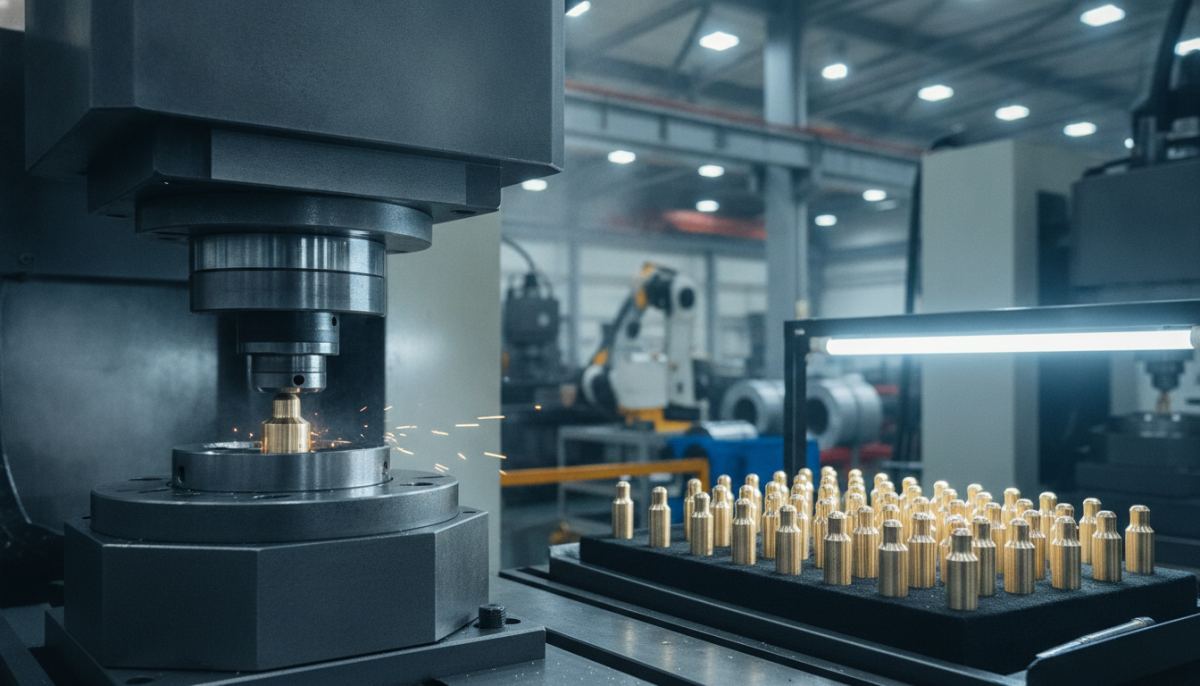
Cold Forging Press Method in Lock Pin Production Guide
Discover how the cold forging press method enhances lock pin manufacturing with superior mechanical strength, micron-level accuracy, and high efficiency.
Lock mechanisms form the foundational architecture of mechanical access control and perimeter defense. Whether examining a standard euro-profile cylinder, an industrial padlock, or an intricate commercial lock set, the mechanical reliability and key-matching accuracy depend almost entirely on internal components known as lock pins. In contemporary industrial lock manufacturing, maintaining micron-level dimensional tolerances across millions of cycles while reducing material waste is a significant operational challenge. To achieve both high tensile durability and extreme dimensional consistency, advanced manufacturing facilities increasingly implement the cold forging press method in lock pin production. This net-shape forming process shapes brass, steel, and technical alloy wires at room temperature under massive hydraulic or mechanical pressure, yielding components with structural properties superior to those produced by traditional chip-removal methods.
Unlike conventional subtractive machining, cold metal forming manipulates metal workpieces along their natural crystalline grain structure without severing metallurgical fibers. This preserved fiber orientation delivers remarkable resistance against continuous shear stress, cyclic loading, and the repetitive friction caused by repeated key insertions and retractions. For specialized commercial facilities, educational campuses, and corporate real estate using multi-level master key systems, cylinders require precisely tiered pin stacks involving bottom pins, master split wafers, and driver pins. In such hierarchical security matrices, even infinitesimal variations in pin height or surface roughness can lead to system malfunction or lock jamming, making the repeat accuracy of cold forging indispensable.
The Critical Role of Lock Pins in Cylinder Mechanisms and Manufacturing Precision
A conventional pin tumbler cylinder operates through a synchronized interplay of key pins (bottom pins), driver pins (top pins), and precision coil springs housed within vertical pin chambers. When the authorized key enters the cylinder plug, its milled bitting cuts lift each bottom pin to a distinct elevation. Proper operation demands that the interface between the key pins and driver pins aligns perfectly with the cylindrical boundary separating the rotatable plug from the stationary housing—an interface known in lock engineering as the shear line. If any pin deviates from its calibrated dimensions by even a hundredth of a millimeter, the shear line remains obstructed, resulting in key binding, mechanism seizure, or vulnerability to physical manipulation such as picking and bumping.
Lock pins are far from passive mechanical dowels; they endure dynamic mechanical forces throughout their service life. Every rotation of the plug transfers torsional shear onto the pins, while spring-back action drives them against the key blade during withdrawal. Consequently, geometry, surface smoothness, and core material hardness must work in unison. In high-security cylinders, hardened steel or stainless steel pins are strategically placed in forward chambers to prevent attack from high-speed drilling. Conversely, standard chambers frequently rely on free-cutting or cold-heading brass alloys prized for natural lubricity, high corrosion resistance, and stable mechanical properties. Selecting a production process that safeguards these intrinsic metallurgical benefits is vital.
To retain uncompromising tolerances during massive production runs, manufacturers assess production methods through the lens of structural integrity and dimensional repeatability. Modern industrial workshops utilizing metal part forming with cold forging technology ensure that lock pins achieve exceptional concentricity, superior shear resilience, and friction-reducing surface finishes that minimize wear against the inner walls of the brass cylinder body.
How Does the Cold Forging Press Method Work in Lock Pin Production?
The cold forging press process operates on the principle of plastic metal deformation below the material’s recrystallization temperature, typically at ambient workshop temperatures. By forcing solid metal into hardened steel or tungsten carbide die cavities under immense kinetic pressure, the material flows to take the exact negative shape of the tooling. In producing miniature, stepped, or domed components like lock tumblers, manufacturers deploy multi-station transfer headers or cold forming presses running automated sequential cycles.
The manufacturing process follows several synchronized mechanical stages:
- Coil Uncoiling and Wire Straightening: Bulk raw wire coiled onto spools—typically precision-drawn brass or low-carbon steel—feeds into the cold forming header. Motorized roller straighteners remove any residual curvature or axial deflection from the wire spool, ensuring perfect cylindrical alignment before tooling entry.
- High-Speed Precision Shearing: The straightened raw stock moves against a physical stop that precisely calibrates the cutoff length. An internal shear blade slices the wire into individual preforms known as slugs or blanks. Volumetric accuracy at this step is critical; any variance in slug mass causes erratic cavity pressure or defective flash formations during pressing.
- Transfer and Multi-Stage Station Heading: Mechanical transfer fingers grip the sheared slug and index it across sequential die cavities. At the initial station, an upsetting punch forms the chamfer, pilot tip, or conical point of the bottom pin. Consecutive strokes form specific operational features, such as retaining steps, anti-pick spool contours, serrations, or spring centering cavities.
- Sizing Calibration and Positive Ejection: In the final die station, a sizing stroke applies calibrating force to establish critical outer diameters and overall lengths within microscopic allowances. Mechanical knockout pins then push the completed lock pin from the die pocket into collection chutes, clearing the tooling for the subsequent stroke.
These mechanical sequences occur at rapid speeds, cycling hundreds of times per minute. Such automated systems enable high-capacity runs where every consecutive lock pin exhibits identical dimensional fidelity. Utilizing dedicated cold forging press stamping machinery guarantees that the physical limits of metal flow are respected, yielding defect-free components that perform smoothly in commercial hardware.
Comparative Advantages of Cold Forging Over Subtractive Machining
For decades, lock pins were manufactured predominantly through subtractive turning operations using single-spindle or multi-spindle automatic lathes. Even today, for low-volume specialty runs, prototyping, or highly asymmetrical custom security cores, utilizing serial machining with CNC automatic lathes provides an adaptable and flexible manufacturing pathway. However, when considering standard high-volume lock pin production, the financial and physical advantages of cold forging presses become clear across several performance metrics.
The most immediate distinction lies in raw material utilization. Machining processes carve geometry by turning solid bar stock into loose metal shavings, which leads to notable raw material loss, especially when generating stepped or contoured security pins. Cold forging, by contrast, relies on volume conservation; metal is plastically displaced rather than cut away. In projects using valuable non-ferrous alloys like copper-zinc brass, this near-zero scrap output dramatically lowers the unit manufacturing cost across enterprise production batches.
Mechanical resilience provides another decisive advantage. Subtractive tools slice directly through the longitudinal grain boundaries of drawn metal bars, introducing localized microscopic notches that act as stress concentration points under cyclical fatigue. Cold heading redirects these internal metallurgical grain lines smoothly around steps, tapers, and heads. Furthermore, cold plastic deformation initiates strain hardening (work hardening), which elevates the pin’s surface yield strength and wear resistance without the necessity, cost, or distortion risks of secondary thermal hardening.
Finally, surface integrity deserves close scrutiny. Cold forging tooling features high-polish, mirror-lapped carbide surfaces that transfer directly onto the forged pin. The resulting surfaces are virtually free of spiral tool paths, chatter patterns, or cutting burrs commonly left by turning tools. This mirror-like surface drastically decreases friction within the lock cylinder chambers, ensuring fluid key insertion and eliminating internal drag over decades of active building operation.
Common Production Defects and Quality Control in Cold Forging Lock Pins
Achieving dependable micro-forging performance requires tight process management, advanced die engineering, and consistent lubrication chemistry. Minor oversights in tooling design or raw material consistency can trigger manufacturing defects. Typical issues encountered in industrial production include:
- Volumetric Inconsistency and Flash: Inconsistent cutoff lengths during slug shearing introduce excess material into the closed die. The surplus volume forces its way out along tooling split lines, generating microscopic thin fins or flash. Rectifying this demands continuous servo-driven wire feeding and scheduled maintenance of shearing blades.
- Die Underfilling (Incomplete Heads): Insufficient press tonnage, suboptimal punch geometry, or trapped air within the cavity can prevent metal from completely filling sharp profile radii or pin steps. Mitigating underfilling requires calibrated punch pressures, proper venting channels, and high-efficiency boundary lubricants.
- Internal and Surface Micro-Fissures: If raw wire undergoes severe reduction beyond its plastic deformation threshold, internal micro-voids or external shearing cracks can develop. Wire raw material must undergo thorough metallurgy tests to verify uniform tensile strength, clean internal inclusions, and appropriate ductility before running through tooling.
- Tooling Wear and Creep Deviation: After millions of consecutive impacts, carbide dies gradually succumb to frictional erosion, leading to dimensional drift on critical diameters. Deploying tungsten carbide inserts alongside balanced high-pressure synthetic lubricants preserves die longevity and maintains process stability.
Stringent quality assurance protocols rely on sample lot testing where automated optical profile projectors, coordinate measuring machines (CMM), and digital microhardness testers inspect production runs. If any deviation in pin step elevation or shaft diameter exceeds predetermined tolerances, press technicians immediately adjust machine stroke positions and tool offsets.
Frequently Asked Questions About Lock Pin Cold Forging
What materials are most suitable for cold-forged lock pins?
The most versatile and widely utilized alloys are specialized cold-heading brass formulations, such as CuZn36Pb2As or CuZn37, which offer an ideal balance between malleability and machinability. For high-security cylinders and drill-resistant barriers, low-carbon alloy steels, case-hardening steels, and austenitic or ferritic stainless steels (such as AISI 303 or 304 variants) are commonly formed through multi-stage cold headers.
Do lock pins require post-forge heat treatment?
Brass pins generally do not require subsequent heat treatments because the strain hardening generated during room-temperature plastic deformation naturally bolsters surface strength and durability. However, steel lock pins intended for drill protection and heavy-duty wear often undergo post-forming thermochemical treatments, such as gas carburizing, carbonitriding, or selective induction hardening, to achieve elevated surface Rockwell ratings.
Can complex security pins with deep grooves be produced purely via cold forging?
Standard cylindrical, domed, stepped, and gently tapered pins are completely suited for pure cold forging. However, complex security profiles featuring deep spool undercuts, sharp mushroom heads, or serrated peripheral rings may require a hybrid production method: cold forging forms the primary cylindrical blank, followed by rapid secondary groove-rolling or light lathe trimming to detail the anti-picking profile.
At what production volumes does cold forging tooling become cost-effective?
Cold forging demands upfront investment in precision carbide tooling, specialized punch holders, and comprehensive setup calibration. Consequently, it delivers exceptional unit economics on large manufacturing runs ranging into hundreds of thousands or millions of parts. For very small, short-run bespoke prototypes, conventional turning methods remain more accessible.
Engineering Reliable Security Solutions for High-Volume Lock Manufacturing
In physical hardware manufacturing, the security and reliability of an entire locking system depend on the integrity of its smallest internal parts. Even the most robustly cast cylinder shell or armored padlock body can fail in the field if internal pins experience premature dimensional wear, uneven shearing, or surface friction seizure. The cold forging press methodology delivers dimensional accuracy, structural fiber continuity, and refined surface finishes that elevate the dependability of the complete mechanical assembly.
For architectural facilities, industrial complexes, and commercial lock systems requiring high precision and scalable component manufacturing, partnering with experienced production specialists is essential. To discuss technical specifications, explore contract hardware manufacturing, or discover our high-capacity forming capabilities, contact us today to consult directly with our technical team.
İlginizi Çekebilir