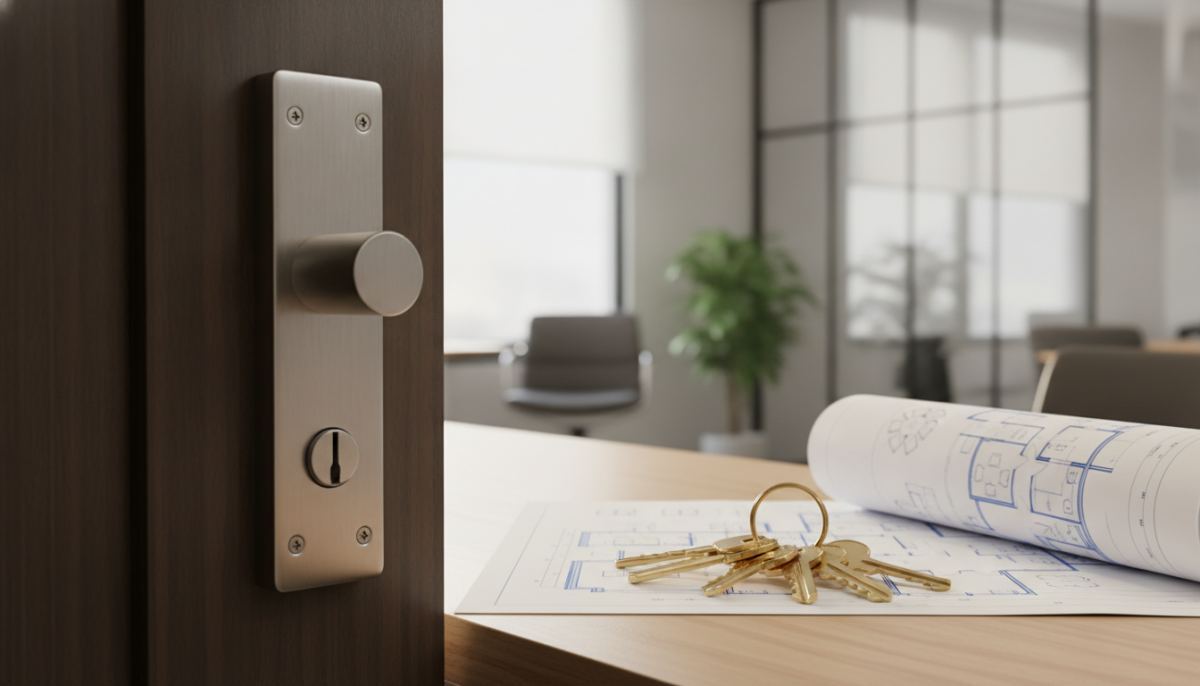
Office Master Key Systems: Access Authorization Planning
Learn how to design an office master key system, build a tiered access authorization matrix, and secure workplace entry points. Plan your setup today.
In modern corporate environments, physical security extends far beyond simply locking exterior entrances at the close of business. True operational control requires an organized framework that dictates which team members can enter specific rooms, under what circumstances, and at what level of clearance. As companies grow, physical keys frequently proliferate across departments without centralized governance. This unchecked expansion often triggers logistical disorder, operational bottlenecks, and severe security blind spots when keys go missing. Implementing tailored master key systems provides an elegant mechanical solution, translating organizational hierarchy directly into physical door hardware while eliminating key ring clutter.
Developing an access authorization blueprint for a commercial workplace demands a structured risk assessment of every workspace, ranging from executive boardrooms and IT server spaces to archives, utility closets, and communal meeting hubs. Distributing keys arbitrarily without an overarching access plan makes it virtually impossible to assess perimeter vulnerability when an employee loses a badge or physical key. Conversely, a tiered access matrix maintains uninterrupted daily workflows, restricts unauthorized interior movement, and ensures authorized supervisors or safety personnel can open every door swiftly during critical emergencies.
What Is an Office Master Key System and How Does It Function?
A master key mechanism is a mechanical engineering design in which individual lock cylinders with distinct internal pin codes can also be operated by an authorized higher-level key. In a conventional pin-tumbler lock cylinder, there is a single shear line formed by pairs of bottom pins and top driver pins. Master-keyed cylinders, however, incorporate specialized master wafers (split spacer pins) between the top and bottom pins. These additional split points create multiple alignment variations along the shear line, enabling two or more completely distinct key blade profiles to rotate the plug smoothly.
Because this functionality relies entirely on precision mechanical tolerances, it remains impervious to power outages, software glitches, Wi-Fi drops, and drained battery units. For multi-department corporations and growing businesses, exploring master key system benefits for SMEs reveals an infrastructure that is both cost-effective and dependable over decades of regular use. When engineered correctly, the system eliminates jurisdictional conflicts among personnel while enforcing strict physical access boundaries throughout the premises.
Establishing a Tiered Access Hierarchy in the Workplace
Structuring access authorization in a commercial office mirrors the corporate organizational chart. By categorizing physical spaces into distinct tiers of privilege, facilities managers prevent unnecessary foot traffic across sensitive departments. Standard commercial hierarchies generally feature three or four operational tiers:
- Keyed Different (KD) Individual Keys: These keys operate only one dedicated cylinder. They are issued to individual staff members who need access exclusively to their own private office, personal workstation, or dedicated storage unit.
- Group Master Key (GMK): A departmental key designed to open all doors assigned to a single administrative division. For instance, a human resources manager might hold a GMK that unlocks interview rooms, HR archive storage, and staff offices within the HR wing, but cannot unlock accounting or IT infrastructure doors.
- Master Key (MK): Carried by facilities directors, operations executives, or primary security officers, this key operates every standard office door and communal workspace across an entire business location.
- Grand Master Key (GMK): In large corporate campuses, multi-story office towers, or companies managing multiple facilities, this top-tier key commands all individual cylinders and sub-master groupings across independent buildings.
Balancing these tiers requires precise combinatorial calculations to prevent accidental cross-keying, where an unauthorized key opens an unrelated cylinder. Business owners must evaluate facility risks thoroughly by determining the security tier of a master key system before cutting cylinders and assigning mechanical privileges.
Step-by-Step Guide to Creating an Office Key Authorization Matrix
Every successful commercial master key implementation starts with an authorization matrix. This schematic blueprint functions as a comprehensive two-dimensional grid linking specific physical entryways directly to job roles, clearance levels, and personnel responsibilities.
The initial phase involves physical surveying and assigning an identifier to every entrance. Facilities teams map all entry points onto architectural floor plans, identifying main entrances, executive suites, conference halls, utility shafts, and fire egress pathways. Every location receives a functional classification based on asset sensitivity. Server rooms containing digital infrastructure, payroll file archives, executive suites, and main electrical panels are designated as restricted, high-security zones requiring stringent clearance parameters.
The second phase categorizes personnel by operational workflow. Security planners assess the daily movement of departmental teams alongside custodial staff, after-hours cleaners, property management teams, and emergency responders. This analysis defines baseline access windows and corridor permissions. In communal storage closets, supply lockers, or outdoor utility sheds where standard mortise cylinders are impractical, integrating keyed-alike padlocks harmonizes exterior locks with the overarching facility strategy, eliminating standalone keys.
The final phase finalizes the matrix for manufacturing. Locksmith engineers analyze the clearance grid to calculate pin configurations, master wafer heights, and chamber depths across all cylinders. Professional planning accounts for expansion, leaving reserve pin variations open so that future team expansions or departmental relocations do not disrupt existing keyways.
Common Risks and Vulnerabilities to Avoid in Lock Hierarchies
A frequent error during master key deployment is failing to anticipate future organizational growth. If an enterprise installs a system designed strictly for its current door count without spare key coding channels, adding ten new offices later may exhaust the mathematical combinations of the keyway. When combinatorial limits are reached, introducing new doors requires either rekeying the entire facility or accepting severe security compromises. Choosing commercial cylinders with advanced pin counts and complex profiles provides ample room for organizational scaling.
Another major vulnerability stems from inadequate key duplication controls. Standard commercial key blanks can be duplicated at retail lock shops without proof of ownership. To preserve perimeter integrity, facilities should specify patented keyway systems that require a verified authorization card and official credentials before duplicates can be manufactured. This restriction prevents employees from making illicit spares for unauthorized friends or contractors.
Finally, the lack of an ongoing key management log compromises physical security over time. Facilities administrators should implement a formal checkout ledger or digital inventory system that tracks key serial numbers, issue dates, and signature acknowledgments. When departing workers fail to return keys during offboarding, an undocumented key inventory makes it impossible to determine which interior spaces have been compromised.
Frequently Asked Questions About Office Lock and Access Systems
Does a lost master key require replacing every lock in the building?
If a top-tier general master key is misplaced, the facility security baseline is compromised, meaning cylinders operated by that key must be rekeyed or modified internally to restore protection. However, if an employee loses a single Keyed Different (KD) office key, facilities teams only need to rekey that specific cylinder to match a new individual key while maintaining its connection to the overarching master key. The remaining offices remain untouched.
What key level should be issued to after-hours cleaning and maintenance staff?
Custodial teams typically receive a service master key programmed strictly for common areas, shared corridors, public restrooms, and general waste disposal points. High-security zones, including IT server rooms, financial archives, and executive offices, remain excluded from custodial keys, requiring dedicated supervisory escorts during scheduled cleaning windows.
Can existing office door locks be converted into a master key system?
Yes, provided the installed architectural hardware utilizes standard commercial mortise, rim, or European profile cylinders. In most cases, existing lock bodies, levers, and strike plates remain intact on the door. Technicians replace only the internal key cylinders with precision-machined, master-keyed cylinders configured to the corporate authorization plan.
How do mechanical master keys integrate with electronic badge access?
Modern commercial buildings frequently deploy hybrid physical security models. Electronic credentials, proximity badges, or biometric readers control high-throughput exterior perimeters and main department thresholds, providing automated audit trails. Interior office doors, server racks, and storage suites utilize mechanical master cylinders to deliver cost-effective security without wiring, while also serving as mechanical overrides during electronic system faults.
Sustaining Long-Term Physical Access Governance
A properly structured master key ecosystem simplifies day-to-day facility management, controls unauthorized movement, and safeguards valuable corporate assets. Maintaining its operational reliability requires regular mechanical upkeep, periodic cylinder cleaning with non-oil dry lubricants, and consistent audits of the master key register to reflect staffing changes.
If you are planning an office expansion, streamlining key management across multi-room workspaces, or seeking tailored commercial cylinder solutions, our experienced engineering team is ready to design a scalable access infrastructure. To discuss your project specifications and receive technical guidance, please contact us.
İlginizi Çekebilir