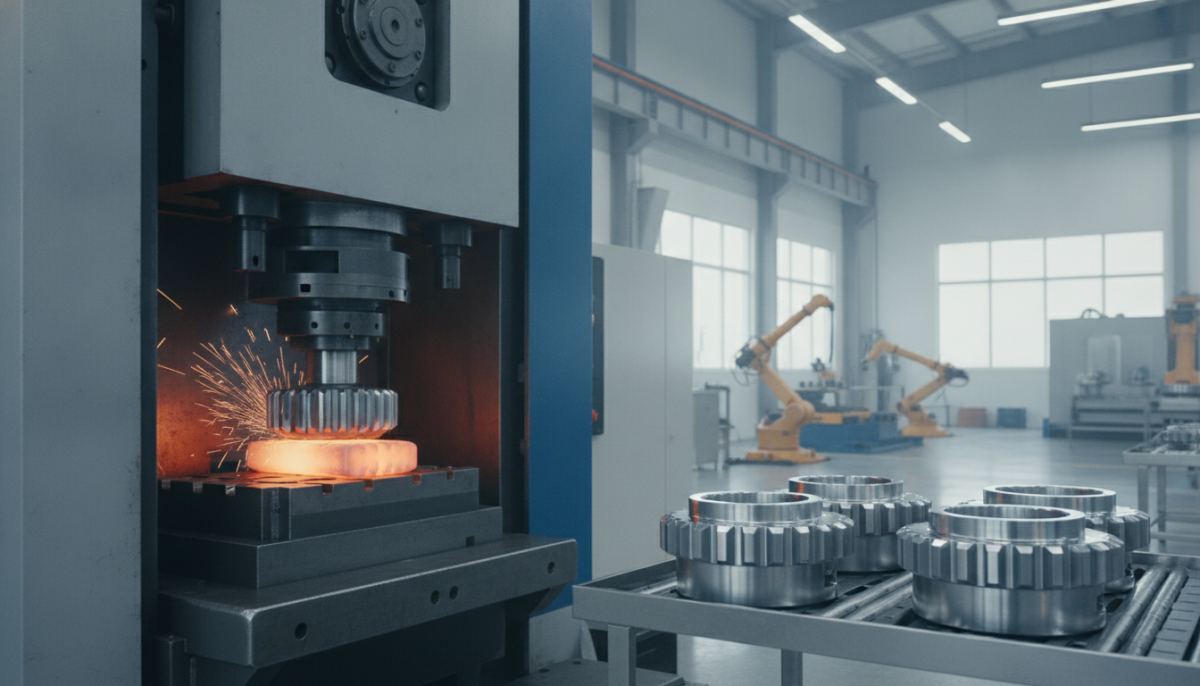
Cold Forging Technology: Metal Forming & Die Design
Learn how cold forging technology enhances metal forming with superior grain flow, precision die design, and material efficiency. Explore key processes.
In modern mechanical manufacturing and precision hardware fabrication, engineering demands often dictate strict dimensional tolerances, superior surface finishes, and high dynamic load resistance. Among the various metal deformation processes available, cold forming stands out as one of the most reliable methods for producing high-integrity components. Cold forging technology shapes ductile metals below their recrystallization temperature—predominantly at ambient room temperature—using specialized high-tonnage mechanical or hydraulic presses and precision-engineered tool steel dies. Unlike conventional subtractive machining operations that generate substantial scrap chips, this plastic deformation approach preserves the continuous grain flow of the raw material, delivering exceptional mechanical performance.
For serial manufacturing of mission-critical hardware, industrial cold forging press stamping has become a foundational standard across the automotive, defense, building hardware, and high-security locking sectors. By forcing raw metal slugs into engineered cavities under immense compressive stress without thermal heating, manufacturers achieve repeatable, near-net-shape geometries. This methodology eliminates unnecessary secondary operations while providing consistent structural stability throughout extensive production batches.
What Is Cold Forging Technology and How Does It Work?
Cold forging relies on the intrinsic plasticity and ductility of metals to induce controlled plastic deformation without raising the workpiece to forging temperatures. The operational cycle typically begins with uncoiled wire rod or drawn round bar stock, which is sheared into precise volume billets, commonly referred to as slugs. These pre-lubricated slugs are then automatically transferred to multi-station tooling systems where high-strength punches drive the metal blank into configured die cavities under immense kinetic energy and localized hydrostatic pressure.
Subjected to stress levels exceeding its yield strength, the crystalline structure of the metal flows into the die contours. The three primary deformation modes utilized in cold forming operations include:
- Forward Extrusion: The metal blank flows in the identical direction of the descending punch stroke, forcing the material through an orifice to reduce its cross-sectional diameter. This approach is widely used for producing stepped shafts, drive pins, and elongated cylindrical components.
- Backward (Reverse) Extrusion: The metal flows in the direction opposite to the punch movement, rising upward into the annular clearance between the punch and the die wall. This method is the primary solution for manufacturing hollow cylindrical bodies, blind-hole sleeves, and lock cylinder housings.
- Radial Forming and Heading: The slug is axially compressed between opposing tools, causing the material to expand outward perpendicular to the press stroke. This technique forms expanded flanges, bolt heads, collar shoulders, and security lock mechanism catches.
Because the metal undergoes plastic deformation at ambient temperatures without thermal oxidation, the workpiece remains entirely free from surface scale. Consequently, cold-forged parts exhibit surface roughness values comparable to precision ground or finely milled finishes directly off the press.
Engineering Advantages of Cold Forging in Metal Forming
The principal engineering distinction between cold forging and alternative manufacturing processes—such as sand casting, die casting, or multi-axis CNC milling—lies in the metallurgical integrity of the resulting component. When a part is machined from solid bar stock, the natural metallurgical grain lines of the metal are severed at sharp transitions and cut faces. In contrast, cold forging redirects the grain structure so that it flows unbroken along the external and internal contours of the part. This continuous grain boundary alignment significantly enhances fatigue strength, shear resistance, and structural impact toughness.
Furthermore, cold deformation initiates work hardening (strain hardening) within the crystalline lattice of the metal. As dislocations interact and multiply under localized compressive strain, both the tensile strength and the yield strength of the material increase substantially. This mechanical phenomenon enables design engineers to specify lower-carbon, cost-effective base alloys while achieving the final mechanical strength typically associated with post-heat-treated alloy steels. As a direct result, part wall thicknesses can be optimized to reduce overall component weight without sacrificing structural rigidity.
Material utilization efficiency represents another distinct advantage of the process. While conventional subtractive milling can waste significant portions of the starting material as recyclable chips, cold forging operates on near-net-shape manufacturing principles. Slugs are cut to the exact volumetric requirements of the finished part, reducing raw material waste to negligible levels. In high-volume industrial production, this raw material conservation yields substantial cost savings over time.
The Role of Cold Forging in Lock and Security Hardware Manufacturing
Physical security components, architectural locking devices, and industrial locking systems operate under demanding mechanical conditions, requiring exceptional resistance against tampering, torsional shear, friction wear, and forced entry attempts. Heavy-duty locking products, such as industrial keyed-alike padlock systems, require shackle bodies, internal locking cams, and locking lugs that possess dense, pore-free microstructures and superior surface hardness. Cold forging provides the structural density needed to eliminate the micro-porosities often found in cast metal housings.
Similarly, entrance security assemblies in commercial and residential properties—such as the specialized electric rim cylinder mechanism installed in high-traffic access doors—must endure continuous rotational cycles, spring friction, and sudden mechanical impacts. Fabricating the internal core pins, outer sleeves, and drive cams via cold forging ensures precise dimensional repeatability down to narrow tolerance bands. These consistent dimensions ensure smooth internal mechanics, prevent cylinder binding, and extend the functional service life of the hardware.
In window safety and secondary structural barrier applications, cold-formed components are equally vital. High-tensile pins and retention catches used in a PVC window security device must resist prying forces and brute mechanical leverage. The metallurgical refinement achieved through strain hardening allows these metal brackets and locking hooks to withstand severe leverage forces without brittle fracture, significantly increasing overall perimeter security.
Die Design and Material Selection in the Cold Forging Process
The operational efficiency and dimensional precision of cold forging rely heavily on sophisticated tool engineering and metallurgical selection. During the deformation cycle, cold forging punches and die inserts are subjected to extreme cyclical pressures reaching several gigapascals, combined with severe frictional sliding. To prevent tool deformation, premature fatigue cracking, or abrasive wear, tooling engineers utilize advanced powder metallurgy tool steels or micro-grain tungsten carbide inserts.
Key engineering considerations in cold forging die design include:
- Stress Distribution and Fillet Radii: Avoiding sharp interior transitions by engineering generous radii to minimize stress concentrations that could otherwise lead to fatigue cracks under cyclical loading.
- Pre-Stressed Reinforcement Rings: Encasing brittle tungsten carbide die cores inside multiple concentric high-tensile steel stress rings (using precision shrink-fit or tapered press-fit techniques) to induce compressive pre-stresses that counteract internal hydraulic tensile forces.
- Surface Preparation and Tribology: Applying specialized conversion coatings—such as zinc phosphating combined with reactive soap lubricants or modern polymer films—to prevent metal-to-metal galling, lower the coefficient of friction, and extend punch longevity.
On the workpiece side, materials must possess sufficient uniform elongation and low initial yield strength. Commonly used metals include low-to-medium carbon steels, case-hardening alloy steels, brass, copper, and various cold-heading grade aluminum alloys. When extreme multi-stage deformation is required, intermediate process annealing (subcritical or recrystallization annealing) is integrated between pressing stations to restore material ductility.
Challenges and Quality Control Steps in Cold Forging
Although cold forging delivers high repeatability, unmonitored process variables can result in tooling wear or component defects. Typical challenges include punch misalignment, incomplete cavity filling (underfill), surface galling caused by lubricant breakdown, and internal micro-cracks resulting from excessive localized strain rates.
To maintain narrow dimensional compliance across industrial runs, manufacturers implement comprehensive quality assurance protocols:
- Raw Material Incoming Inspection: Verifying chemical composition, surface seam depth, grain size, and wire diameter tolerances to ensure uniform slug volume.
- Dimensional and Geometric Verification: Utilizing automated optical gauging systems, high-precision air gauges, and multi-axis coordinate measuring machines (CMM) to verify critical concentricity, perpendicularity, and diameter tolerances.
- Hardness and Non-Destructive Testing: Employing Vickers or Rockwell micro-hardness testing alongside eddy-current or ultrasonic flaw detection to confirm appropriate strain-hardening levels and verify the absence of internal fractures.
Frequently Asked Questions About Cold Forging Metal Forming
What is the primary difference between cold forging and hot forging?
Hot forging heats the metal above its recrystallization temperature, lowering the yield strength and allowing complex, heavy shapes to be formed with lower press tonnage; however, high temperatures cause surface oxidation, scale formation, and looser dimensional tolerances. Cold forging is conducted at room temperature, producing superior surface finishes, tight dimensional tolerances, and higher final strength due to strain hardening.
Can cold forging be applied to any type of metal?
No. Cold forging requires materials with sufficient ductility and plasticity at room temperature. Low-to-medium carbon steels, aluminum alloys, copper, and brass are well-suited for this process. High-carbon steels, tool steels, and brittle alloys tend to crack under room-temperature deformation and generally require hot forging, warm forging, or conventional machining.
How long do cold forging dies typically last?
Die longevity depends on the complexity of the part geometry, the forming pressures involved, lubrication efficiency, and tool steel composition. High-precision tungsten carbide dies with physical vapor deposition (PVD) wear coatings, such as titanium carbonitride (TiCN), frequently achieve production runs ranging from hundreds of thousands to over a million cycles under proper maintenance protocols.
Does cold forging completely eliminate the need for CNC machining?
In many applications, cold forging delivers true near-net-shape or net-shape components that require no secondary metal cutting. However, features that cannot be formed axially in a single die stroke—such as internal threading, lateral cross-holes, deep undercut grooves, or micron-level bearing seats—may still require minimal secondary machining operations.
Determining the Right Manufacturing Parameters in Industrial Component Production
Maximizing the benefits of cold forging requires careful collaboration during early product design. Designing components specifically for cold material flow—by standardizing wall transitions, utilizing generous draft angles where beneficial, and avoiding unnecessary asymmetric geometries—lowers tooling costs while accelerating cycle rates.
Manufacturing engineers must calculate appropriate press tonnage, stroke velocity, lubrication coatings, and progressive station layouts according to the deformation resistance of the specified alloy. For scalable high-volume production runs, custom component development, and contract manufacturing solutions, contact our expert technical team to evaluate your component drawings and optimize your parts for efficient cold forming production.
İlginizi Çekebilir