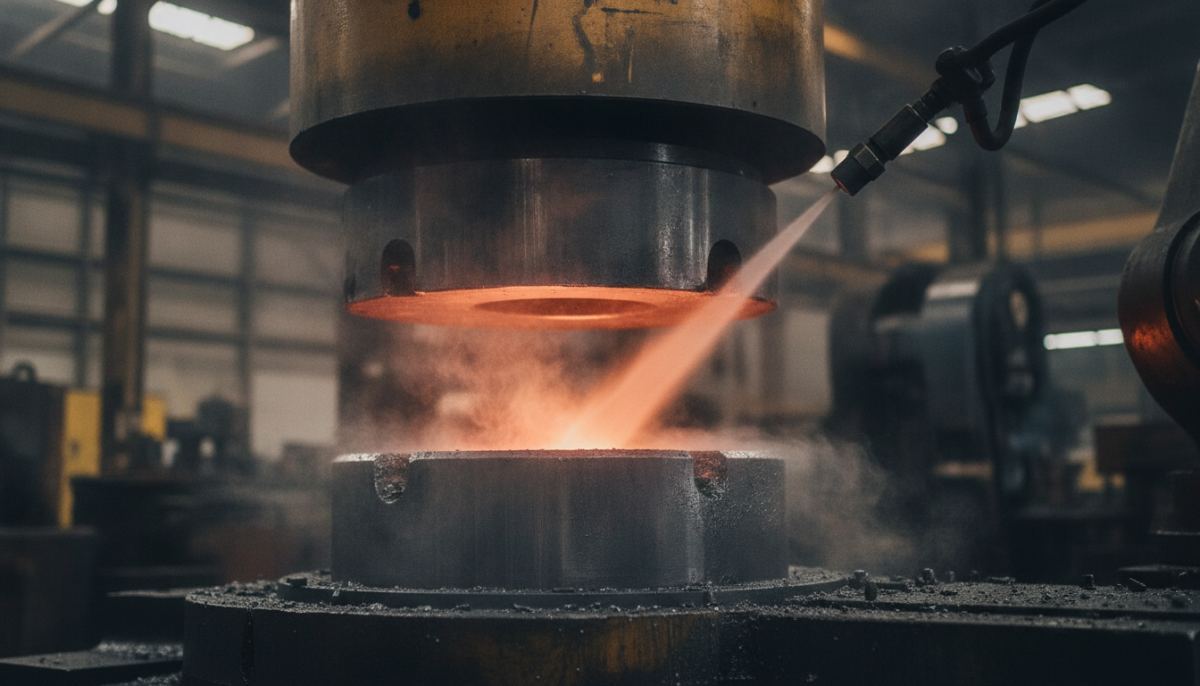
Causes of Wear in Hot Forging Press Dies
Discover the causes of wear, thermal fatigue, abrasive wear factors, and methods that extend die life in hot forging press dies from our guide.
Tools operating under high temperature and pressure in industrial metal forming processes are exposed to continuously variable mechanical and thermal loads. In hot forging press systems, which are widely used in the mass production of brass, steel, and non-ferrous alloys, the direct contact of the die surface with the workpiece at temperatures close to melting creates an inevitable wear environment. The loss of the die's geometrical precision and surface quality causes the final part to go out of tolerance, increases the amount of flash, and leads to unforeseen downtimes on the production line. Therefore, the accurate analysis of die wear mechanisms is a critical necessity to maintain production efficiency and keep the cost per part at a minimum level.
Wear Phenomenon and Importance in Hot Forging Press Dies
In the hot forging process, the die not only creates a mechanical counterforce; it also defines the flow paths that enable the hot metal to fill the die cavity homogeneously. Every microscopic deformation occurring on the die surface is directly reflected on the surface of the forged part. In the manufacture of precision-requiring components such as lock bodies, hydraulic parts, or machine elements, the slightest distortion in the die profile jeopardizes the assembly capability and mechanical resistance of the part.
Another dimension of die wear that must be monitored with seriousness is energy and material loss. As the die wears, metal flow resistance increases, and press machines expend higher tonnage to achieve the targeted geometry. Unaddressed die wear goes beyond simple maintenance steps that could resolve it, leading the die to completely turn into scrap. In cases where material deformation involves different dynamics, alternative methods may come into play; for instance, for room-temperature forming where thermal effects are absent, cold forging technology can be evaluated and process management can be planned over different wear patterns.
Main Mechanisms Triggering Die Wear
The deteriorations encountered in hot forging dies do not stem from a single cause; rather, they are a combination of complex and self-feeding physical mechanisms. The main types of wear limiting die life are:
- Abrasive Wear: As the high-temperature metal billet flows into the die cavity, hard oxide scales (scale) formed on the material surface act like sandpaper. Deep scratches and cavities emerge through this mechanism in the radii and narrow bottlenecks of the die most exposed to material flow.
- Adhesive Wear: At moments when pressure and temperature peak, local micro-welds occur between the workpiece and the die. When the die opens, these welded areas tear off, detaching micro-particles from the die material and creating crater-like structures on the surface.
- Plastic Deformation: In cases of extreme loading where the yield limit of the die material is exceeded, crushing, sagging, or accumulation is observed, especially in sharp corners and thin walls. This situation generally arises from the inability of the die hardness to be maintained at the working temperature.
- Thermal Fatigue (Heat Checking): In each pressing cycle, the die surface suddenly heats up and then rapidly cools with cooling fluids. This cyclical expansion and contraction cause spider web-like micro-cracks (heat checking) to form on the die surface.
Effect of Thermal Fatigue and Mechanical Stresses on Die Life
In the hot forging process, the temperature gradient on the die surface is extremely steep. When the metal billet contacts the die, the surface layer instantly reaches high temperatures, while the core region of the die remains relatively cool. The surface layer wants to expand, but the cold core restricts this movement; this creates intense compressive stresses on the surface. When the part is removed from the die and coolant fluid is sprayed, the surface rapidly contracts, and this time tensile stresses dominate.
This thermomechanical cycle, repeated hundreds or thousands of times a day, pushes material limits. Microscopic cracks that are initially invisible deepen with each cycle under the influence of billet scale and lubricant chemicals. When stress concentrations at crack tips combine with the mechanical press blow, it can lead to particle chipping (spalling) from the die or the die cracking and breaking from the body. The way to keep this cyclical fatigue under control is not to skip the preheating stage of the die and to keep the die temperature constant at a certain rate throughout the operating period.
Die Material Selection and Heat Treatment Errors
The most fundamental factor determining die life is selecting the tool steel suitable for working conditions and applying the correct heat treatment procedure to this steel. Hot-work tool steels are expected to simultaneously possess high-temperature yield strength, wear resistance, toughness, and thermal conductivity. Although alloys such as DIN 1.2344 (H13), DIN 1.2365, or DIN 1.2387 are generally preferred, the chemical composition of the material alone does not provide sufficient assurance.
Hardening and tempering errors made during heat treatment leave the die vulnerable to wear. While insufficient tempering makes the die overly brittle, causing premature cracking, a lower-than-required hardness value causes the die to quickly succumb to abrasive wear and plastic deformation. Furthermore, the machining quality of the die is also directly effective. To ensure dimensional stability in die nests and pins for finely-geomerized parts, precise tolerance inspections similar to quality control principles in CNC automatic operations should be performed, and machining marks and surface micro-notches must be completely cleaned by polishing.
The Role of Lubrication, Cooling, and Process Parameters
The function of lubricants in a hot forging environment is twofold: to reduce friction by creating a separating film layer between the die and the workpiece, and to prevent overheating by exhibiting heat transfer from the die surface. Traditional graphite-water-based suspensions or new-generation synthetic lubricants must be homogeneously sprayed onto the die surface at the correct flow rate and angle. At points where lubrication is insufficient, metal rubs directly against metal, and adhesive sticking becomes inevitable. Conversely, excessive and irregular application of cooling fluid leads to shock cooling in the die, accelerating thermal fatigue cracks. In addition, the temperature control of the billet heating furnace has a direct impact on wear. Metal billets heated more than necessary produce denser scale, multiplying the abrasive effect, while insufficiently heated cold billets place abnormal mechanical impact on the die.
Surface Engineering and Maintenance Steps Preventing Die Wear
Surface engineering techniques are frequently utilized to increase die strength. Gas nitriding, plasma nitriding, or PVD/CVD coating methods (e.g., TiAlN or CrN coatings) form a hard barrier layer on the die surface. This layer protects the die against both abrasive scratches and high-temperature material diffusion. Regular operation of preventive maintenance processes prevents wear from turning into irreversible damage. A checklist that can be applied before and after each shift includes the following steps:
- Preheating Verification: Before running the press, it must be ensured that the die has reached the recommended operating temperature (usually in the 150-250°C band) via burners or electric heaters.
- Scale Cleaning and Air Blowing: It must be observed that scale and residues in the die cavity are completely evacuated with compressed air after each stroke.
- Optical and Dimensional Control: The die surface should be inspected for microscopic cracks and radius erosions at certain production counts; critical dimensions must be verified with the help of gauges.
- Periodic Polishing and Stress Relieving: Mild fatigue marks appearing on the surface should be removed with light polishing before they deepen, and stress relief annealing should be performed on dies that have completed the required working hours.
Frequently Asked Questions About Wear in Hot Forging Dies
How is it understood that a thermal crack (heat checking) has formed in the die? The appearance of spider web-like capillary lines on the die surface and micro-lines in the form of bumps on the surface of the produced part indicate that thermal fatigue has begun. The depth of the cracks can be detected at an early stage using a magnifying glass or liquid penetrant tests.
What kind of wear or damage occurs if die preheating is not performed? When a hot billet at around 1000°C is suddenly pressed into a cold die, a severe expansion difference arises between the surface and the body. This situation can cause the tool steel at the brittleness limit to crack upon the first strokes, corner parts to break off, or the die to suddenly split.
What is the most effective method in reducing abrasive wear? Proper scale cleaning of the billet as it leaves the furnace, applying hardening surface treatments such as nitriding to the die surface, and using a parting lubricant of correct viscosity significantly limit the abrasive effect.
Ways to Improve Die Performance and Production Continuity
Extending the life of hot forging dies is possible not only through the common discipline of the die workshop, but also through the entire production chain from material supply to the press operator. Thanks to correct tool steel selection, flawless hardening, a balanced lubrication-cooling cycle, and timely applied preventive maintenance routines, die life can be increased exponentially. This approach reduces scrap rates while ensuring that part dimensional quality remains stable throughout the batch.
Avoiding sharp radii during the design phase, distributing wall thicknesses evenly, and pre-detecting stress concentration points in material flow with forging simulations eliminates the risk of wear at its source. Depending on the part geometry and tolerance requirements, utilizing alternative forming processes can also provide a cost advantage; accordingly, within the scope of facility capabilities, non-ferrous production models can be structured by disabling temperature-induced wear with cold forging press solutions. To determine the die and metal processing solutions suitable for your needs, contact us to speak with our expert engineering team.
İlginizi Çekebilir