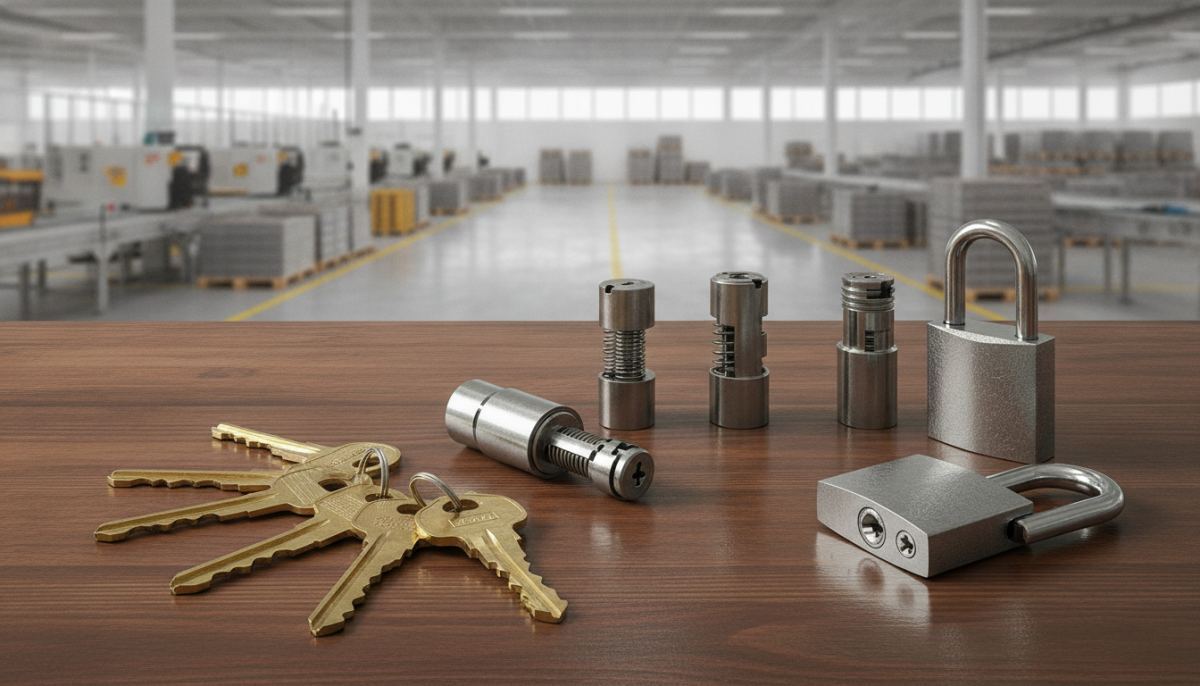
Industrial facilities, production floors, and logistics warehouses are complex structures that combine hundreds of different doors, cabinets, panels, and access points. Carrying, copying, and tracking hundreds of different keys in these areas both leads to operational inefficiencies and creates serious security vulnerabilities. The use of authorized master key systems in factories and warehouses ties mechanical access control to a specific hierarchy, making it possible for each personnel to enter only their own area of responsibility. This allows facility managers to get rid of the massive keychain clutter, prevents unauthorized entries, and enables immediate intervention in critical points during emergencies.
What Is an Authorized Key System in Industrial Facilities?
An authorized key system is the configuration of mechanical lock barrels and padlocks according to a specific authorization matrix using special pinning combinations. While each key opens only a single lock in standard lock structures, a single barrel can be opened by multiple different key profiles in hierarchical systems. In this architecture, the key of a working employee opens only their own workspace (for example, only the packaging line door); the shift supervisor's key opens the entire department, while the general manager's or facility security manager's key opens all locks in the factory.
The security dynamics of industrial facilities differ from the scenarios encountered in the service sector. For example, while the use of master keys in hotels and hostels generally focuses on floor- and room-based hierarchies, factories contain much higher-risk sensitive areas such as flammable material warehouses, transformer rooms, raw material stores, and CNC machining workshops. Therefore, industrial authorization directly supports occupational health and safety (OHS) standards alongside operational speed.
Graded Lock Hierarchy Matrix for Factories and Warehouses
For the key system to operate efficiently in factories and warehouses, a pyramid structure suited to the organizational chart of the facility must be established. A poorly planned hierarchy may cause barrel changes and additional costs in later periods. Gradation in a typical industrial facility generally consists of four main levels:
- Grand Master Key: Allocated for the use of the factory manager, security manager, and fire/emergency teams. It opens all administrative buildings, production lines, warehouses, and technical rooms within the facility.
- Master Key: Defined for relevant section chiefs or unit managers. It opens only the locks belonging to that department (for example, only the paint shop and chemical warehouse) and does not provide access to other departments.
- Sub-Master Key: Given to a specific shift or cell leader. It opens only the machine locks and intermediate warehouses under the responsibility of the relevant shift.
- Individual Key: Belongs to the operator, maintenance personnel, or warehouse clerk. It opens only a single door or personal tool cabinet assigned to the personnel.
Note: The structure in the table is exemplified according to general industry norms; the number of levels should be adapted by expert technical teams according to the architectural and administrative requirements of your facility.
Padlock Integration in Multi-Warehouse and Logistics Areas
Padlocks are used instead of standard door barrels in open yards of industrial facilities, container storage areas, construction site barracks, and power distribution panels. Having a separate key for each lock at these points causes ramp supervisors and field security guards to carry dozens of keys. As a solution, padlock groups that work integrated with the master system or open each other are put into play.
Thanks to padlock systems that open each other, a warehouse chief can inspect [20] different container locks or [50] different material cages in the field with a single key. The body and handle strength of locks used in industrial environments is also of great importance. Advanced metal shaping methods, such as cold forging press forming applied in the production of parts requiring high resistance to heavy conditions, impacts, and cutting, ensure that lock bodies have a long service life against industrial wear.
Compatibility with Access Control and Electric Automated Systems
Main gates, personnel entry turnstiles, emergency exit guides, and fire doors in factories are frequently monitored with electronic access control hardware. However, fire regulations and power outage scenarios make it mandatory to have a mechanical key bypass option at these access points. Electric automation [tubular barrel] hardware used at facility main entrances and fire escape corridors both work integrated with the electric locking mechanism and can be included in the master key system.
This mechanical-electronic hybrid structure allows security guards to manually disable the electric lock mechanism with a single master key during system failures or emergency evacuations. Thus, the speed brought by automation and the uncompromising security offered by mechanical locking combine in a single center.
Common Mistakes Made in Factory Authorized Lock Systems
Some planning and management mistakes frequently made when designing master key projects in industrial facilities can cause the system to lose its functionality in a short time:
- Keeping the Authorization Matrix Too Broad: Giving an unnecessary number of doors-opening keys to each personnel for operational convenience disrupts the authorization logic and makes theft/loss tracking impossible.
- Neglecting Copy Security: Using ordinary key profiles without security cards paves the way for personnel to make unauthorized copies of the key at an external locksmith. Patented or security carded profiles should be preferred.
- Failing to Account for Future Growth: Pin combinations calculated without considering new warehouse, additional building, or production line investments of the facility lead to the system clogging by reaching capacity limits within [1-2] years.
- Lack of Lost Key Protocol: Not preparing a standard operating procedure (SOP) beforehand regarding which lock combinations will be revised when a master key is lost risks facility security.
Application and Audit Checklist for Facility Managers
You can follow the steps below sequentially to convert the lock infrastructure in your existing facility into an authorized system or to set up the right system in a new factory project:
- Create a Door and Lock Inventory: Document the types and measurements of wooden, sheet metal, fire, electrical panel, and padlock points throughout the facility one by one.
- Draft an Authorization Matrix: Determine which titles should enter which buildings and rooms with department managers and OHS experts.
- Leave Reserve Capacity: When consulting with your lock manufacturer, request code combination quotas for new lock barrels that can be added in the future at a rate of at least [%20-30].
- Establish Key Handover and Assignment Procedures: Assign the serial number of each key to the personnel; integrate the return obligation upon resignation into HR processes.
- Get Expert Manufacturer Support: Contact authorized lock systems experts to engineer the special pinning hierarchy your facility needs and bring the right technical solution to life.
Frequently Asked Questions About Factory and Warehouse Key Systems
Do all locks in the factory need to be changed when a key is lost?
No, in a modular and professionally designed authorized master key system, it is not necessary to change all locks. If the lost key is a lower-level individual key, only the pin arrangement of the barrel opened by that key is reconfigured or replaced. In the event that the Grand Master key is lost, existing lock bodies can be preserved by revising the inner pins of the locks to a new encryption profile.
Can padlocks and door barrels be opened with the same master key?
Yes. In industrial master key systems, the barrel cylinder and the internal encryption core of the padlock can be manufactured to have the same pin structure. This way, as seen in professional master key solutions, an authorized person can open both the production building door and the material cage master key padlock in the field with the same key.
Can the system be expanded later for newly added doors or warehouses?
In a correctly planned master lock project, "reserve combinations" are set aside during the engineering phase. When a new warehouse building or additional ramp doors are subsequently added to your facility, new barrels matching your existing key hierarchy can be produced and included in the system without needing to change your existing keys.
How is unauthorized outside copying of authorized keys prevented?
Authorized industrial keys mostly have patented profile structures and security cards. These keys cannot be copied with blank profiles found in standard locksmiths on the market; the production of a new copy or spare barrel is done exclusively by the main manufacturer upon presentation of the security card by the designated person of the facility.