Raw Material Selection Criteria for Cold Forging
Discover critical raw material selection criteria for cold forging press forming. Learn how alloy choice, metallurgy, and coatings impact die wear.
In the high-volume serial production of precision mechanical parts, Cold Forging Press Forming stands out as one of the most efficient manufacturing techniques. Compared to conventional subtractive machining, cold forging delivers exceptional surface finishes, eliminates chip waste, and enhances mechanical strength by preserving continuous metal grain flow lines. Nevertheless, the outstanding operational efficiency and durability promised by cold forming depend almost entirely on the metallurgical attributes of the incoming raw materials. Selecting an incompatible alloy, choosing steel with inadequate purity, or overlooking structural homogeneity can instantly cause microscopic surface cracks, accelerated die wear, unexpected tool fractures, and unacceptable scrap rates. In high-reliability applications such as security lock components, tumbler pins, cylinder plugs, locking bodies, and precision automotive hardware, rigorous raw material selection serves as the decisive technical foundation of the entire engineering process.
The Importance and Core Dynamics of Raw Material Selection in Cold Forging Press Forming
Cold forging is fundamentally defined as the plastic deformation of metal below its recrystallization threshold, virtually always conducted at room temperature. Unlike hot forming techniques, the raw material receives no preheating to lower its yield stress. As a direct consequence, the material retains its initial mechanical hardness and presents significant internal resistance against severe mechanical deformation. Under the tremendous forces exerted by mechanical or hydraulic presses, the raw stock must displace, expand, flow radially, and fill intricate die cavities without developing internal stress tears or surface ruptures. Achieving high yield rates in Metal Part Forming with Cold Forging Technology relies squarely on obtaining raw materials with high ductility, tight chemical tolerances, and a uniform microstructural matrix.
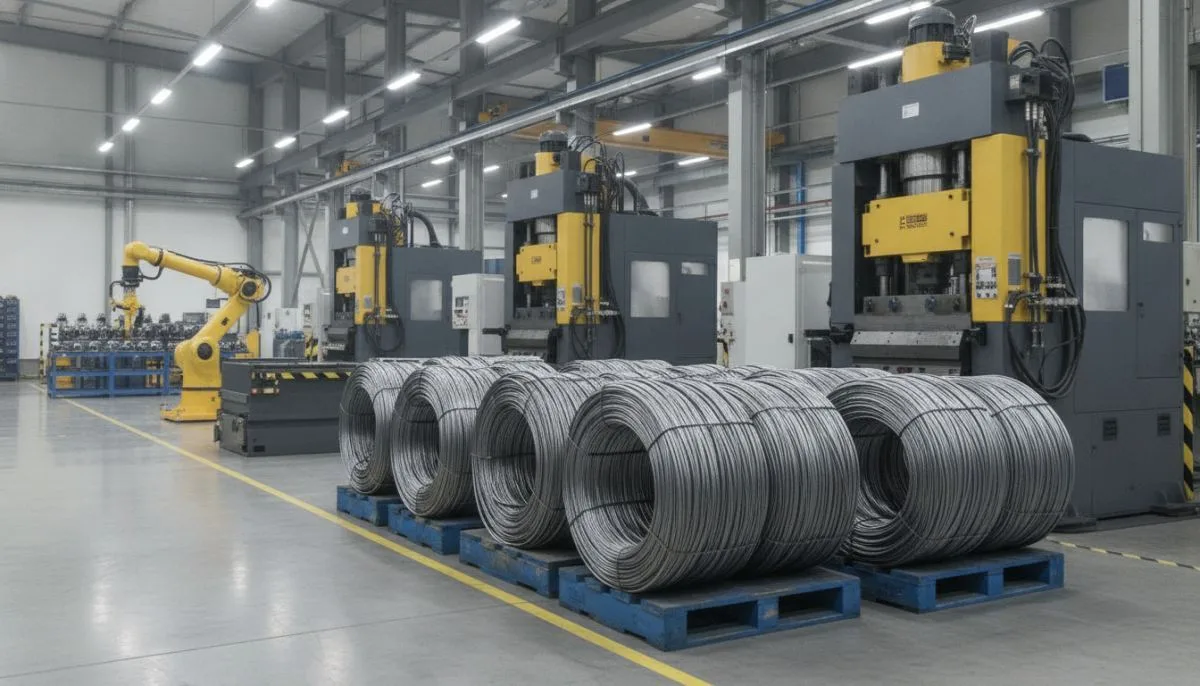
During cold plastic deformation, the crystalline grains of the metallic stock stretch and align in the direction of the applied load. When the raw metal contains non-metallic inclusions, segregations, or uneven chemical distribution, these imperfections act as localized stress concentrations. Under extreme compressive forces, localized stress peaks rapidly propagate into macroscopic cracks or structural splits. For security locking hardware, padlock bodies, and master key cylinders that must withstand harsh environmental wear and severe tampering impacts, the balance between material ductility and post-forming hardness must be calculated meticulously. Sourcing certified, fully traceable coiled wire rods or drawn bar stocks with verified chemical compositions is the non-negotiable initial milestone for dependable serial production.
Metallurgical Properties: Formability, Yield Strength, and Grain Structure
To ensure that the raw stock flows seamlessly inside complex tooling geometries, several metallurgical parameters must be analyzed before mass production begins. The primary parameter is formability, often assessed through cold forgeability or upset testing. High-performance cold forging materials typically feature a low initial yield strength, high tensile elongation, and an expansive plastic deformation zone. Furthermore, the strain hardening exponent of the chosen alloy demands careful monitoring. Alloys that work-harden too rapidly under strain can exhaust their plastic limit before completely filling intricate die recesses, leading either to severe component cracking or catastrophic die punch fractures.
Another decisive metallurgical factor is microstructural grain size and morphology. Steels with fine, uniform, equiaxed grain distributions exhibit far superior flow behavior and deform much more uniformly than coarse-grained structures. Because of this, raw wire rods intended for heavy cold deformation regularly undergo spheroidization annealing. Spheroidizing breaks down brittle, lamellar pearlite into rounded carbide globules embedded inside a ductile ferrite matrix. This spherical carbide morphology permits drastic cross-sectional reductions without generating internal microscopic micro-voids. Furthermore, strict minimization of interstitial impurities, particularly sulfur and phosphorus, is essential to eliminate directional laminations and internal shearing defects during multi-station heading operations.
Common Raw Material Types in Locking Mechanisms and Security Hardware
Components engineered for mechanical security assemblies, cylinder cores, and locking mechanisms must balance robust wear resistance with high impact toughness. When deploying advanced methods such as Cold Forging Press Method in Lock Pin Production, engineers select different raw material categories tailored to the mechanical responsibilities of the final part. The most prevalent alloy families utilized in this domain include:
- Low-Carbon Steels (e.g., C10C, C15C): Featuring low carbon content, these grades provide unmatched cold ductility. They are the premier choice for complex lock casing components, structural rivets, assembly bushings, and fastening pins where high deformation ratios must be achieved without overstressing press tooling. Final surface hardness is subsequently acquired through case hardening treatments.
- Case-Hardening Alloy Steels (e.g., 16MnCr5, 20MnCr5): Widely recognized as the benchmark for locking mechanisms subjected to intense physical attack, drill resistance demands, and continuous cyclic wear. After cold forging, parts undergo carburizing and quenching, resulting in an exceptionally hard exterior case alongside a tough, impact-absorbing core.
- Cold Heading Free-Cutting Steels: Specially balanced steels containing controlled additions of sulfur or lead. These grades provide sufficient formability for cold heading operations while simultaneously offering superior machinability for secondary lathe, drilling, or threading processes.
- Brass and Copper Alloys (e.g., CuZn37, CuZn40): Renowned for their intrinsic corrosion resistance, non-magnetic qualities, and low friction coefficients. These non-ferrous alloys are frequently cold forged into cylinder pins, plug inserts, padlock components, and decorative architectural hardware, offering excellent lubricant retention and seamless metal displacement.
Raw Material Surface Quality, Coating, and Lubricant Carrier Capacity
While internal metallurgy dictates formability, the external surface condition of the raw wire or rod dictates the success of cold forging. Mill scale, oxidation flakes, drawing chatter marks, surface decarburization, and microscopic seams will open into severe cracks when exposed to multiaxial cold forging stresses. Consequently, premier forging facilities insist on utilizing cold-drawn, skin-passed, calibrated wire stock that has undergone non-destructive eddy-current inspection to ensure the absence of surface anomalies.
Under the monumental contact pressures typical of cold press operations, maintaining complete separation between the workpiece metal and the tool steel surface is vital. Direct metal-to-metal contact results in immediate galling, micro-welding, and premature die destruction. To establish a reliable barrier, raw materials undergo chemical surface pre-treatment, most commonly zinc phosphate conversion coating followed by a reactive sodium stearate soap application. The microcrystalline phosphate layer acts as a mechanical carrier that firmly anchors the lubricant film to the workpiece. Even during extreme radial expansion inside high-pressure die corners, this lubricant layer prevents galling, reduces tool friction, and preserves surface smoothness throughout high-speed strokes.
Material-Related Manufacturing Defects and Preventing Die Wear
Suboptimal material selection creates immediate financial repercussions on tooling longevity. Utilizing a steel grade with excessive carbon or unannealed hardness forces the forging press to exert disproportionate tonnage, triggering localized stress spikes on tool faces. Unlike high-temperature forming where thermal fatigue dominates—as detailed when analyzing Causes of Wear in Hot Forging Press Dies—cold forging tooling fails primarily from severe abrasive wear, fatigue spalling, and mechanical chipping. Excessive raw material hardness rapidly deteriorates punch tips and initiates radial cracks within tungsten carbide die inserts.
Other prevalent manufacturing anomalies linked directly to raw material inconsistencies include central bursting (chevron cracking), surface laps, fold defects, and incomplete cavity filling. Chevron cracks, which occur along the longitudinal center of the part, often stem from internal inclusions combined with incorrect die reduction angles. Inconsistent raw material diameter tolerances also present severe operational risks; minute dimensional variations in coil stock cause volumetric fluctuations, generating either insufficient die fill or destructive internal press overloads. Implementing strict dimensional verification and requiring full material test reports for every coil shipment prevents these costly defects.
Frequently Asked Questions (FAQ) About Raw Material Selection in Cold Forging Press Forming
What is the recommended carbon percentage for cold forging steels?
In industrial cold forging, low-carbon steels containing between 0.10% and 0.25% carbon represent the optimal range. Keeping carbon within this bracket maintains low deformation resistance and high material ductility, keeping required press tonnage within safe operational limits. Medium-carbon steels can be cold forged for high-strength applications, but they typically mandate intermediate annealing cycles to restore formability between consecutive forming stages.
Why is spheroidization annealing necessary for cold heading wire?
Following initial hot rolling, steel exhibits a pearlitic microstructure composed of hard, plate-like cementite layers. These brittle lamellae resist plastic deformation and initiate microscopic shear cracks when cold formed. Spheroidization annealing transforms these brittle plates into rounded, spherical carbide particles within the ferrite matrix. This spherical configuration allows smooth, uninterrupted metal displacement without premature cracking and substantially prolongs die life.
Can stainless steel alloys be processed via cold forging press forming?
Yes. Austenitic stainless steels, such as AISI 304 and AISI 316, are regularly cold forged for high-security outdoor locks and marine applications where outstanding corrosion resistance is mandatory. However, austenitic stainless steels possess an exceptionally high work-hardening rate compared to standard carbon steels. Consequently, cold forging stainless steel demands significantly higher press tonnages, heavy-duty carbide tooling, specialized PVD tool coatings, and high-pressure extreme-pressure lubricants.
What happens if wire stock is cold forged without a phosphate conversion coating?
Omitting the phosphate coating eliminates the carrier matrix that holds liquid or dry lubricants in place under extreme contact pressure. Without this barrier, the lubricant film shears away, causing immediate metal-to-metal bonding between the workpiece and die cavity. This produces severe galling, scratches on component surfaces, rapid dimensional deviations, and frequent punch breakage.
Optimal Material Strategy and Production Planning for SMEs
For small and medium enterprises manufacturing precision locking hardware, master key assemblies, and mechanical components, choosing the correct raw material is both a technical mandate and a crucial driver of commercial profitability. High rejection rates caused by split blanks and premature die failures rapidly erase project margins. By aligning part geometry, required mechanical loads, and surface finishing demands with verified metallurgical data during the initial design phase, manufacturers achieve dependable mass production runs at predictable costs.
Whether you require assistance in selecting certified cold heading grades, designing long-lasting die tooling, or executing high-precision contract manufacturing runs for your security products, our engineering team is ready to assist. For custom technical evaluations and project consultations, please contact us today.
You May Also Like Kopyala