The weakest link in a public building’s security is not necessarily the strength of the lock on the door, but the inability to control who can open that door, when they can open it, and with what level of authorization. In institutions containing hundreds of rooms, technical areas, and sensitive archives, key confusion is not merely an operational inconvenience; it is also a serious security vulnerability. In particular, the cost of replacing multiple locks when a key is lost and the chaos caused by being unable to find the correct key during an emergency are making modern public building lock management strategies increasingly important.
You may also be looking to make physical access control within your institution more secure and manageable. In this guide, you will discover professional lock management strategies that establish hierarchical access control in public institutions, prevent unauthorized entry, and raise security standards to the highest level. At Ay Kilit, with our engineering experience dating back to 1964, we explain in detail how to create a hierarchical plan covering the entire building through master key systems and durable cylinder systems. In the following sections, we will examine the operational efficiency provided by local manufacturing and the technical solutions that can be developed specifically for your project.
Key Points
- Learn how to prevent authorization confusion by translating the hierarchy of a public institution into a mechanical structure with master key systems.
- Establish disciplined door inventory and lock matrix creation processes for efficient public building lock management.
- Discover the technical differences between brass and steel cylinder systems that extend service life in high-traffic public areas.
- See how hierarchical planning can minimize costs and security risks instead of replacing the entire system when a key is lost.
- Understand the strategic advantages of local manufacturing and engineering experience dating back to 1964 in technical support and project planning processes.
Table of Contents
What Is Public Building Lock Management and Why Is It Important?
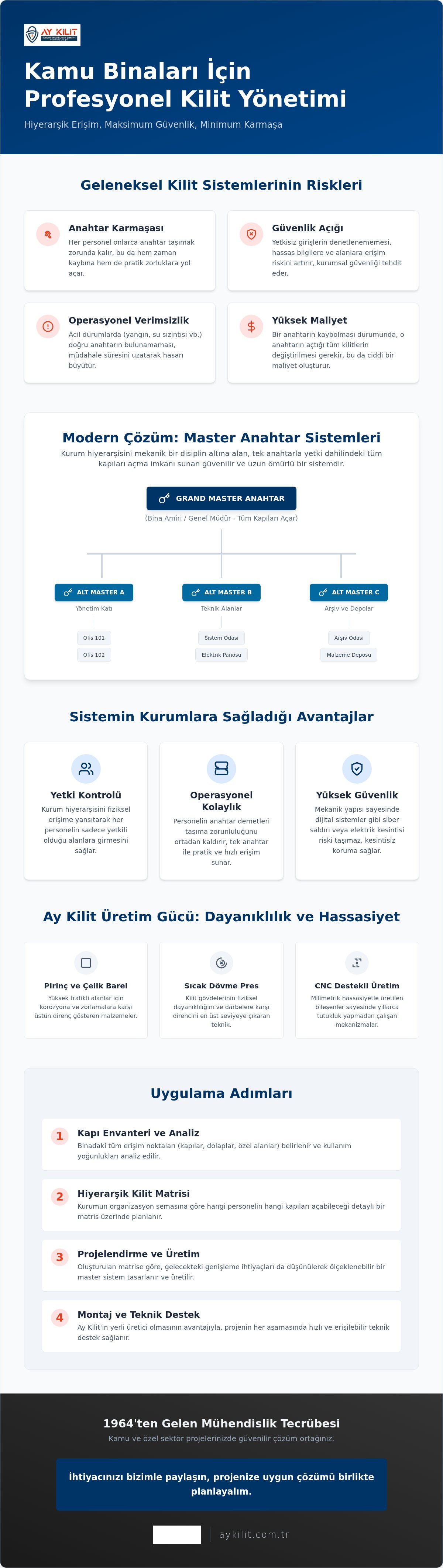
Security in public buildings is not simply about locking exterior doors; it involves physically implementing a complex authorization matrix. Professional public building lock management ensures that every employee, from administrative personnel to technical teams, can access only the areas for which they are authorized. Conventional lock systems create a cumbersome structure in public institutions where employees may need to carry dozens of keys. This results in both wasted time and an uncontrolled security vulnerability. The primary purpose of lock management is to eliminate this inefficiency and bring security under a disciplined mechanical structure.
Many institutions consider digital access control systems to be the only solution, but these systems involve risks such as power outages and high maintenance costs. The master key systems we provide at Ay Kilit combine the unwavering strength of mechanical security with modern engineering principles. Through Hierarchical Master Key Systems, it is possible to manage an entire building with a single key or restrict specific rooms exclusively to authorized personnel. This approach offers a significantly lower-cost, long-lasting, and low-maintenance alternative to digital systems. The operational continuity of mechanical systems creates a sustainable model for public budgets.
Institutional Risks of Key Confusion
There are situations in public administration where even seconds are critical. During emergencies such as fires or water leaks, failure to locate the correct key can extend response times and increase the extent of damage. Furthermore, the inability to control access to rooms containing sensitive documents threatens institutional information security. If an employee loses a key, security protocols may require all locks opened by that key to be replaced. This process represents not only a material cost but also a significant loss of labor. Master lock systems minimize such risks while simplifying administrative control.
Security Standards in Modern Public Buildings
Public buildings are among the environments with the highest levels of daily foot traffic. This intensity makes the physical durability of cylinder systems and lock mechanisms critically important. Brass-bodied locks manufactured using hot forging press techniques provide superior resistance to corrosion and physical force. Components manufactured with millimetric precision through CNC sliding automaton processes allow locks to operate for years without jamming. Working with a local manufacturer prevents disruptions in the supply chain and ensures rapid access to technical support whenever required. At Ay Kilit, we have reflected this discipline in our manufacturing processes through the solutions we have provided for public projects since 1964.
Share your requirements with us, and let us plan the right solution for your project together.
Access Planning with Hierarchical Master Key Systems
The administrative structure of public buildings forms the foundation of physical security planning. Effective public building lock management must accurately translate the institution’s hierarchy into a mechanical key scheme. The master key systems used in this process establish a structure in which each employee can open only the doors within their authorized area, while managers can access the entire building with a single key. This mechanical configuration provides a high level of security without requiring complex software or digital infrastructure. At Ay Kilit, drawing on our experience since 1964, we design these schemes specifically according to each institution’s organizational structure.
Future room additions or departmental changes should also be considered when designing the system. A scalable design eliminates the need to rebuild the entire system when the institution expands. International standards such as the University of Arizona Electronic Access Guidelines emphasize that access planning should address not only current requirements but also future needs. Our CNC-supported serial manufacturing capabilities make it possible to produce additional locks compatible with the same master scheme even years later. This allows the system to be expanded without compromising the institution’s security integrity.
Creating Grand Master and Sub-Master Groups
Grand Master authority represents the highest authorization level and is typically assigned to a building administrator or senior executive. This key can open all master lock groups and individual rooms within the building. At lower levels, restricted permissions are defined according to floors or departments. For example, a floor manager may open only rooms on their own floor, while an employee’s key may open only their own office. This tiered structure increases security while minimizing the number of keys personnel must carry. Cylinder components used in our master-keyed lock systems are manufactured using hot forging press techniques to withstand high-frequency use.
Keyed Alike (KA) Lock Systems
Certain areas within an institution are shared by multiple authorized personnel. Archives, technical rooms, storage areas, and common-use spaces fall into this category. At these points, keyed alike lock systems allow all doors within the same authorization group to be opened with a single key type. This application reduces key-ring clutter and improves operational speed. Components manufactured with millimetric precision through CNC sliding automaton processes ensure that these systems continue operating smoothly even under intensive use.
To create the most appropriate lock scheme for your institution’s hierarchical structure and discuss technical details, you can contact our expert technical team.
Material Quality in High-Security Cylinder and Lock Systems
Public buildings are high-traffic environments where hundreds or even thousands of people use doors every day. This intensive usage means that public building lock management planning must consider not only hierarchical authorization but also the physical strength of the hardware. Cylinder systems, which form the heart of lock mechanisms, are continuously exposed to friction and mechanical stress. Material selection therefore directly determines the overall service life and reliability of the system. Locks manufactured from low-quality alloys can wear rapidly, lose the precision required by the master key scheme, and create security vulnerabilities.
Brass cylinders are an industry standard because of their natural corrosion resistance and precision machinability. However, for intensive use in public buildings, the material should be processed using hot forging press methods. This technique compacts the metal structure, producing a non-porous and significantly more durable body. At Ay Kilit, we use this method in our manufacturing processes to maximize resistance against impact and forced entry. Although steel cylinders offer high resistance to physical attacks, the micron-level machining precision provided by brass bodies remains essential for the flawless operation of complex master lock systems.
Industrial Manufacturing Techniques and Security
Hot forging processes carried out at Ay Kilit provide lock bodies with industrial-grade durability. Through CNC sliding automaton processes, coding pins and spring channels inside the cylinder are machined with millimetric precision. This precision allows the key to rotate smoothly inside the cylinder and extends the service life of the lock mechanism. Our CNC contract manufacturing capabilities enable even the most complex coding combinations to be manufactured accurately. In addition, electrostatic powder coating and specialized surface treatments applied to our products provide robust protection against corrosion in humid or heavily used environments.
Security Layers in Cylinder Lock Systems
Security is not only about durability; it also depends on intelligent engineering solutions. Cylinders manufactured for public buildings are equipped with hardened steel pins to resist drilling. Specially profiled security pins are used to increase resistance against lock picking. In particular, snap-resistant cylinder systems are designed so that the externally exposed section breaks away under force while the internal locking mechanism remains protected. This prevents further external manipulation while preserving authorized operation of the locking mechanism. Security-card-controlled systems also place key duplication control entirely in the hands of the administration, preventing unauthorized key reproduction.
Share your requirements with us, and let us plan the right solution for your project together.
Implementation Checklist for Public Building Lock Management
Before starting a lock management project in a public building, a complete picture of the existing physical infrastructure and administrative hierarchy should be established. A successful implementation process depends not only on product quality but also on meticulous preparation. Professional public building lock management involves much more than simply counting doors; it requires analyzing the functional value of every access point. At Ay Kilit, drawing on our experience since 1964, we help ensure that this transition is carried out without disrupting institutional operations.
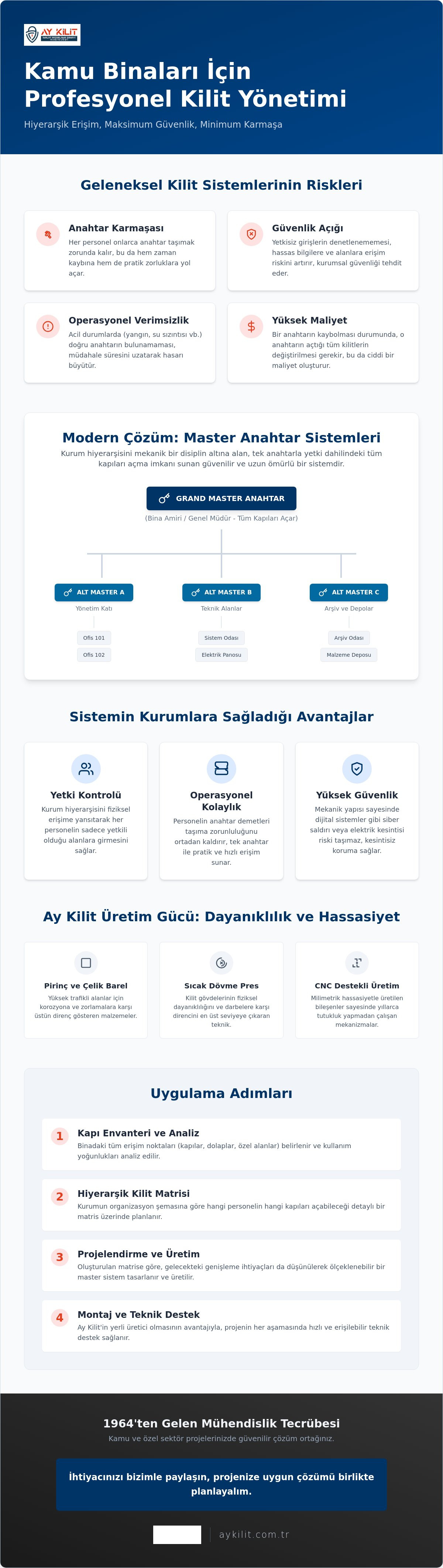
The first stage is to prepare a detailed inventory of all access points in the building. Executive offices, archives, technical areas, and common spaces should be classified into separate categories. Following the inventory, a “Master Lock Matrix” should be prepared showing which positions are authorized to open which doors. This matrix effectively serves as the technical constitution of the project. Lock plans prepared according to engineering principles prevent compatibility problems and security vulnerabilities before the installation stage. The design of master key systems should be customized according to the security requirements of each room.
Preparing a Lock Plan Step by Step
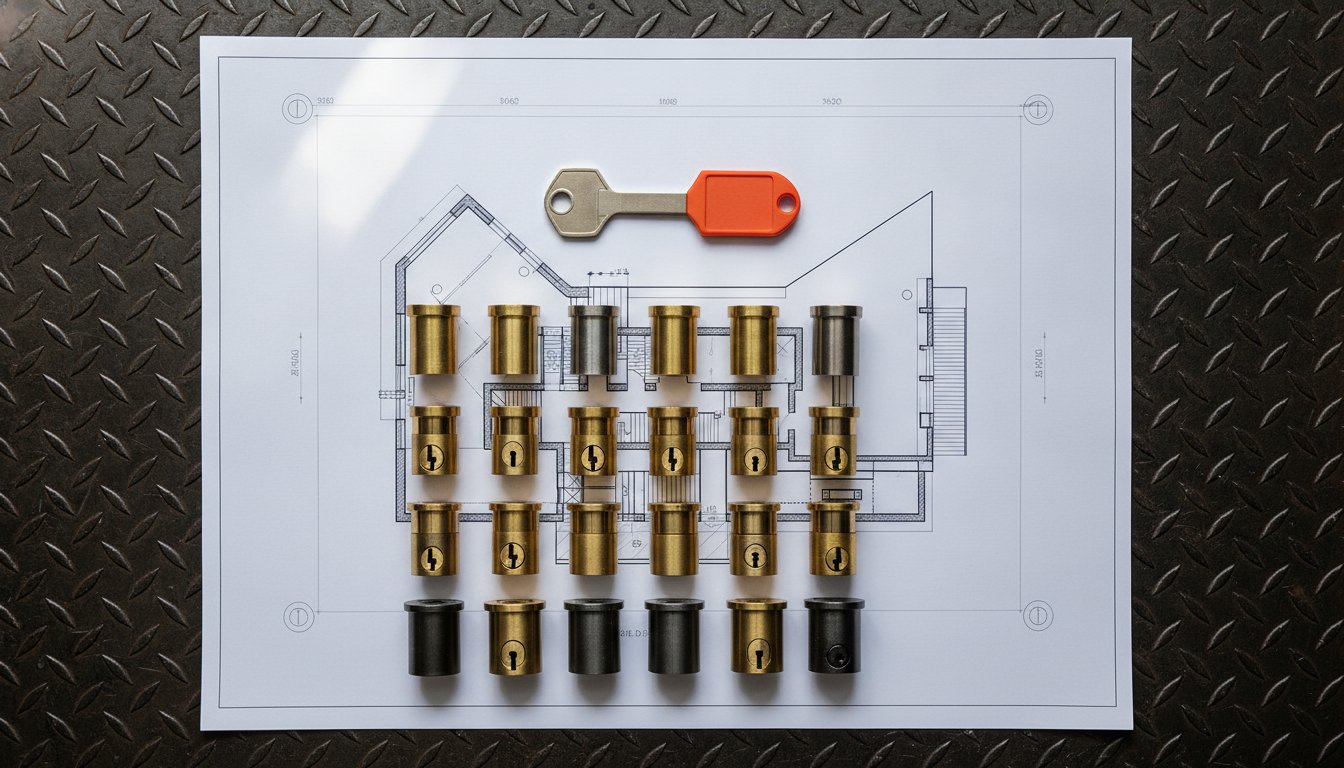
The building’s current architectural plan should serve as the basis for access planning. Every door should be individually numbered, and authorization levels should be defined using these numbers. Manufacturing should not begin until the prepared matrix has received administrative approval. The possibility that a room currently used as an archive could later be converted into an office should also be considered, making flexible coding infrastructures preferable. Through our CNC sliding automaton technology, we manufacture modular cylinder systems capable of adapting to such functional changes and providing a long-term solution.
Maintenance and Sustainability Checks
Once installation is complete, a periodic maintenance schedule should be established to preserve operational efficiency. Lock mechanisms in high-traffic areas should be inspected at defined intervals for dust and dirt accumulation and cleaned using appropriate methods. A key assignment protocol ensures that every employee is institutionally responsible for the key issued to them. If a key is lost, updating only the coding structure of the affected lock group rather than replacing the entire system can provide substantial savings for public budgets. Our durable bodies manufactured using hot forging press techniques allow these technical updates to be carried out smoothly even years later.
To minimize technical risks during implementation and create a security map specifically for your institution, you can receive support from our public projects consulting team.
Share your requirements with us, and let us plan the right solution for your project together.
Custom Manufacturing Solutions for Public Projects with Ay Kilit
Security in public projects requires manufacturing capacity capable of responding to project-specific needs beyond standard products. At Ay Kilit, we combine craftsmanship experience dating back to 1964 with advanced technology to serve as a reliable solution partner for public institutions. In professional public building lock management processes, we operate not merely as a product supplier but as a manufacturer providing technical guidance throughout every stage of the project. Our cylinder systems and lock mechanisms, manufactured to high standards using hot forging and CNC technologies, are designed to deliver long-lasting performance in complex buildings containing thousands of doors.
The hot forging press techniques used in our manufacturing processes maximize metal durability, while CNC sliding automaton processes provide precise dimensional accuracy. This technological infrastructure enables us to manufacture mechanisms suited to the high-traffic conditions of public buildings, with reliable and smooth operation. As a local manufacturer, we provide institutions with time and cost advantages in spare-part supply and technical support compared with imported products. Our project-based manufacturing capabilities allow us to create lock schemes that precisely match the administrative hierarchy of each public building.
Why Choose Locally Manufactured Ay Kilit Solutions?
Working with a local manufacturer for public tenders and bulk procurement is a strategic decision that reduces logistical risks. Ay Kilit can respond rapidly to project-specific modification requirements thanks to the flexibility of its production lines. Problems commonly associated with imported systems, such as extended supply times or component incompatibility, can be addressed through Ay Kilit’s local technical support and rapid manufacturing capabilities. In addition, our expertise in CNC contract manufacturing and automaton processes provides institutions with significant advantages when modernizing older lock systems in existing buildings. Through our after-sales consulting services, we support the long-term sustainability of institutional lock management.
Project Planning Support
The complex structure of public buildings requires technical specifications to be prepared meticulously. The Ay Kilit technical team actively supports institutions in preparing project-specific lock plans and technical specifications. Based on the architectural structure of the building, we determine the most appropriate padlock and cylinder combinations and accurately design the hierarchical access matrix. With our institutional knowledge dating back to 1964 and our modern engineering approach, we help establish public-sector security on a solid foundation. We remain a solution-focused partner throughout every stage of your project.
Share your requirements with us, and let us plan the right solution for your project together.
Strategic Steps for Sustainable Security in Public Institutions
Security in public buildings is measured not only by physical barriers but also by how effectively those barriers are managed in alignment with the institution’s administrative hierarchy. A professional public building lock management structure eliminates key confusion while maximizing operational efficiency and controllability. Hierarchical master key systems and high-strength cylinder structures designed for high-traffic environments provide a cost-effective and reliable way to address the long-term security requirements of public institutions.
At Ay Kilit, we combine our local manufacturing experience dating back to 1964 with hot forging and CNC precision to produce hardware tailored to your project. With our project-based lock planning support, we help you establish mechanical access protocols that align with your institution’s organizational structure. By combining modern engineering principles with decades of manufacturing experience, we support a disciplined and sustainable approach to institutional security.
Share your requirements with us, and let us plan the right solution for your project together.
Frequently Asked Questions
Does a master key system weaken security in public buildings?
No. On the contrary, a professionally designed master key system improves institutional security by restricting unauthorized access. In these systems, each cylinder is engineered to operate only with specifically authorized keys. Eliminating chaotic key management also enables building administrators to access required areas quickly during emergencies, improving operational security. Coding pins manufactured with CNC precision increase the system’s resistance to manipulation.
Can we switch to a master key system without replacing existing door locks?
In many cases, transitioning to a master key system requires replacing only the cylinder systems rather than the complete door locks. If the existing lock bodies are compatible with the required standards, cylinders manufactured specifically according to the hierarchical scheme can be integrated into them. This approach can provide substantial savings for public budgets while also accelerating installation. At Ay Kilit, we manufacture cylinders compatible with existing hardware to help minimize transition costs.
If a key is lost, does the entire system need to be replaced?
No. The entire system does not necessarily need to be replaced; only the coding structure of the cylinders affected by the lost key needs to be updated. Because master lock systems have a modular structure, the affected cylinder group can be recoded and made compatible with new keys. This preserves operational continuity and significantly reduces replacement costs, particularly in public building lock management projects involving hundreds of doors.
Which type of cylinder is more suitable for public buildings?
In public buildings with high levels of human traffic, snap-resistant cylinder systems can provide additional protection against physical attacks. Snap-resistant cylinders are designed so that an exposed section breaks away under force while the core locking mechanism remains protected. Brass cylinders manufactured using forging techniques can also provide long service life, corrosion resistance, and reliable performance in technical areas. The appropriate cylinder type should ultimately be selected according to the door, threat profile, usage frequency, and required security level.
How is a master key scheme or matrix prepared?
A master key scheme is prepared as an authorization matrix based on the institution’s organizational structure. First, the function of each door and the positions authorized to access it are identified. Grand Master, Master or Group Key, and individual key levels are then entered into this matrix. The Ay Kilit technical team can support public institutions during this planning process to establish an accurate manufacturing structure.
What are the advantages of locally manufactured lock systems in public procurement?
Locally manufactured systems provide strategic advantages in logistics speed, technical support, and spare-part availability. Risks such as extended supply times and component incompatibility associated with imported products can be reduced through local manufacturing. Ay Kilit supports project requirements with CNC-supported serial manufacturing capabilities and hot forging technology backed by manufacturing experience dating to 1964.
How should key assignment management be handled in public institutions?
Key assignment management should follow a protocol in which each key is recorded with a unique identification number and issued to personnel against a signed acknowledgment. Laser-marked codes can be applied to keys in master key systems to simplify tracking. Security-card-controlled systems can also be used to prevent unauthorized key duplication without institutional approval. This discipline reinforces physical security with administrative control.
Are mechanical systems or card access systems more durable?
The answer depends on the building, usage scenario, maintenance conditions, and required level of auditability. High-quality mechanical lock systems can provide long service life with relatively simple maintenance, while card access systems offer advantages such as event logging, rapid credential cancellation, and flexible authorization changes. For many public buildings, a hybrid strategy that uses mechanical master key systems alongside electronic access control at critical points can provide a more balanced approach to resilience, manageability, and security.