In industrial manufacturing, perfection is not a preference; it is a requirement for survival under the increasingly competitive conditions of 2026. Many businesses face significant cost increases in contract metal parts manufacturing due to micron-level tolerance deviations or unpredictable lead-time delays. You are likely aware that these technical disruptions in the supply chain, combined with a lack of engineering-level consultancy, can undermine operational efficiency and disrupt production targets.
In this guide, we examine in technical detail the tangible value that integrated manufacturing solutions, from CNC sliding headstock automatic lathe technologies to hot forging, can bring to your business. Drawing on Ay Kilit’s extensive experience dating back to 1964 and its modern engineering vision, you will discover how to maximize part precision and establish a reliable manufacturing partnership. In the following sections, we analyze step by step the strategic advantages of managing forging and machining processes under one roof, green transformation regulations in industry, and current manufacturing dynamics for 2026.
Key Takeaways
- Understand in technical detail how integrating hot forging and CNC sliding headstock automatic machining processes delivers both high strength and micron-level precision in manufactured parts.
- Learn how professional contract metal parts manufacturing solutions can optimize operational efficiency by eliminating the need for major fixed-capital investments and associated maintenance costs.
- Minimize procurement risks by evaluating five critical technical criteria when selecting a manufacturing partner, including the number of machining axes, technological capabilities, and DFM (Design for Manufacturability) analysis.
- Discover how more than 60 years of manufacturing discipline and corporate reporting capability can support consistent quality in high-volume projects.
- Analyze the requirements and solutions introduced to metalworking processes by 2026 industrial green transformation regulations and emerging technical standards.
Table of Contents
What Is Contract Metal Parts Manufacturing? Industrial Scope and Definition
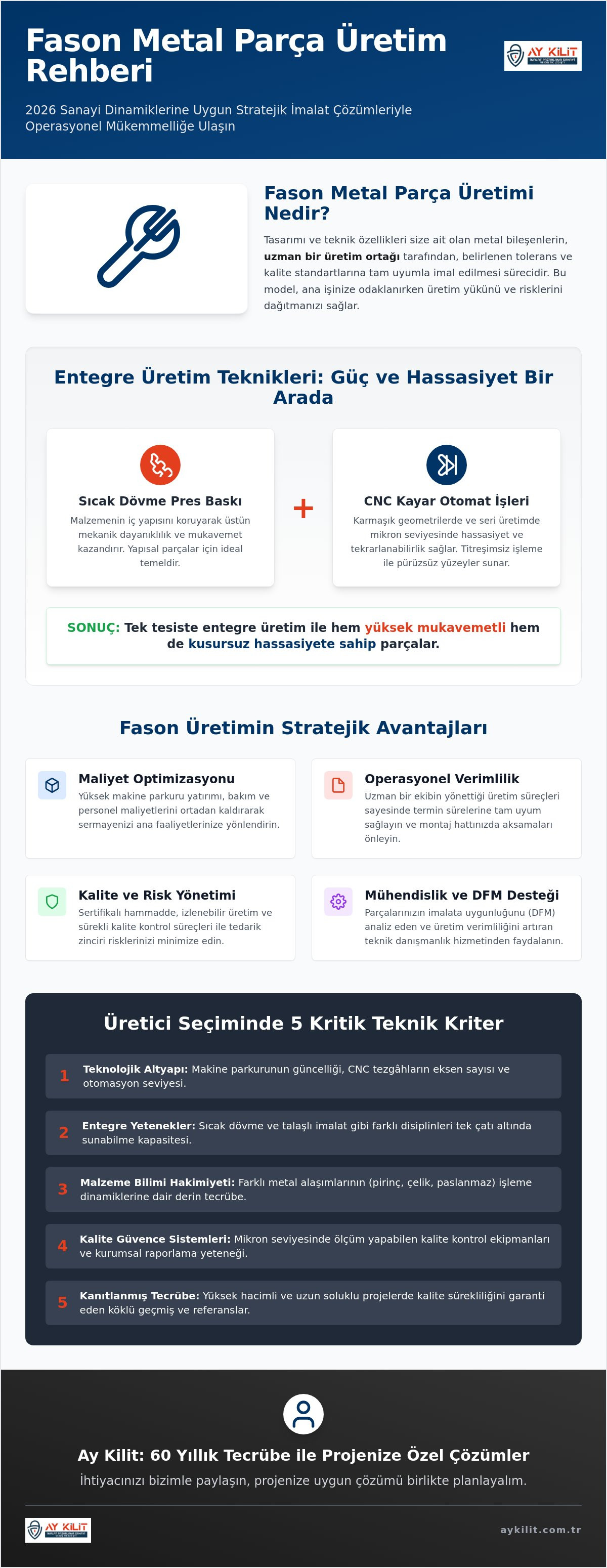
A cornerstone of industrial manufacturing, contract metal parts manufacturing is the process in which components designed and technically specified by one company are manufactured by specialized external production facilities. This business model is defined in global literature as Contract Manufacturing and enables brands to distribute production risks while focusing their resources on engineering and core business capabilities. In a process that requires strict adherence to technical drawings, production itself is only one element; design-for-manufacturability analysis and technical consultancy also play critical roles.
In modern industry, this manufacturing model has evolved beyond a simple supplier relationship into a strategic partnership. Core technologies such as machining and hot forging are used in an integrated manner according to the application requirements of the component. Forging is generally preferred for structural parts requiring high strength, while CNC technologies are used where micron-level dimensional precision is required. A professional manufacturer can supply parts as semi-finished or fully finished components, directly contributing to the efficiency of your assembly line.
The Role of Machining and CNC Automatic Lathe Technology
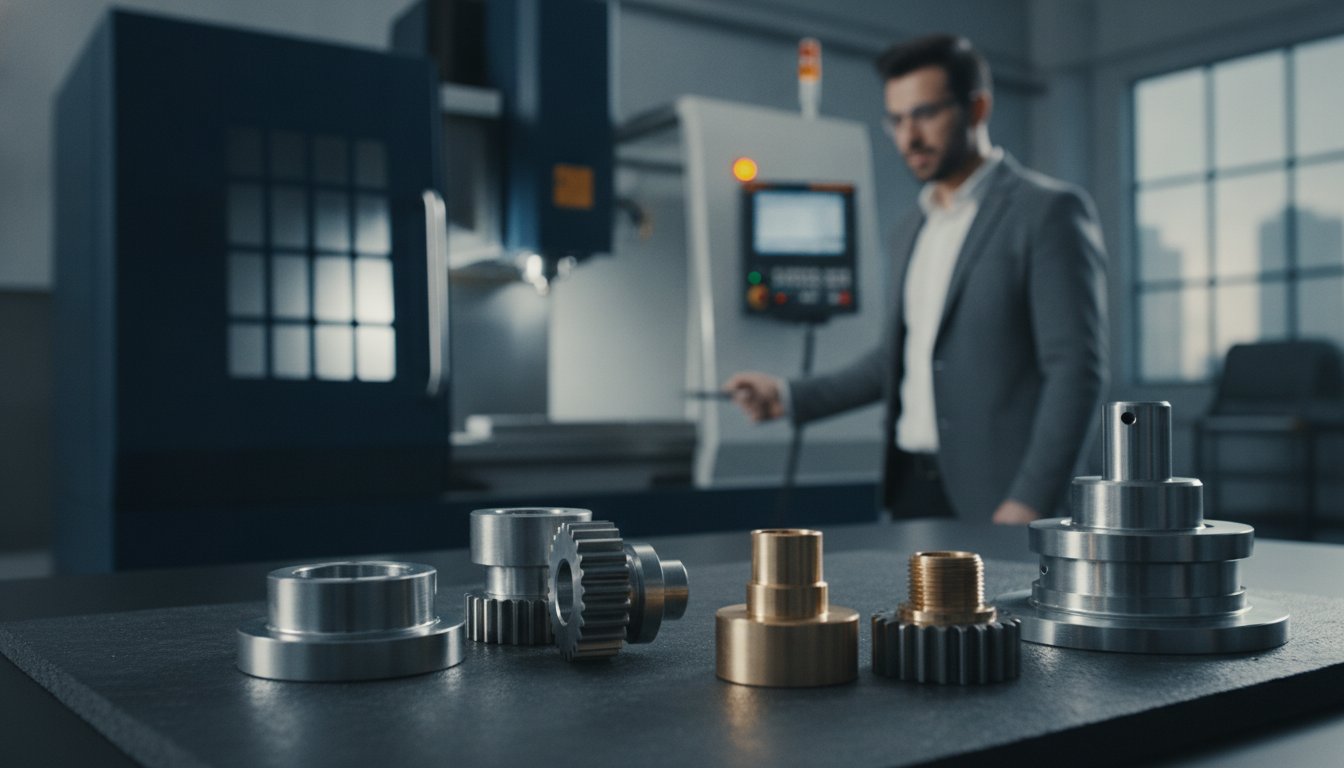
CNC sliding headstock automatic lathes represent one of the highest levels of speed and repeatability in serial production. These machines minimize errors caused by manual intervention while transforming complex component geometries into finished parts through computer-aided manufacturing (CAM) software. Micron-level tolerance management enables components to fit together with high dimensional consistency. Particularly in high-volume orders, this technical discipline helps ensure that every component is manufactured according to consistent quality requirements.
Raw Material Selection and Materials Science
An effective contract metal parts manufacturing process begins with a thorough understanding of materials science. Metals such as brass, carbon steel, stainless steel, and aluminum have significantly different machining characteristics. Material hardness directly affects both surface quality and machining time. In B2B processes, documentation relating to raw material composition, traceability, and applicable safety information supports compliance with technical and international requirements.
Working with specialized manufacturers provides access not only to machinery but also to years of accumulated materials-processing expertise. This engineering knowledge helps prevent costly losses caused by incorrect material selection. Within the 2026 industrial landscape, such technical capabilities remain among the key factors determining a company’s competitiveness in global markets.
If you would like to explore applications of similar technical capabilities in gate automation and security systems, learn more about Kaputechnika Bolt and discover its industrial solutions.
CNC Sliding Headstock Automatic Machining and Hot Forging: Integrated Manufacturing Techniques
One of the most important factors determining component quality in industrial manufacturing is the compatibility of the selected production methods. In contract metal parts manufacturing, combining hot forging and CNC technologies under one roof can provide significant operational advantages compared with relying on a single production method. Components shaped through hot forging gain high mechanical strength as the material’s grain flow follows the geometry created during forming. The forged blanks are subsequently machined on CNC equipment to achieve their final dimensions. This integration combines structural strength with dimensional precision.
Completing production within a single facility reduces logistical complexity and uncertainty in lead times. Transporting components to another location for secondary operations after forging can increase costs and create discontinuities in quality control. An integrated facility allows every stage, from incoming raw material to packaging of the finished product, to be managed under a unified engineering discipline. This creates a critical advantage for businesses seeking speed and cost efficiency in the 2026 industrial environment.
CNC Sliding Headstock Automatic Machining and Precision Manufacturing
CNC sliding headstock automatic technology is particularly effective for manufacturing long and slender components where conventional fixed-head lathes may encounter stability limitations. The guide bushing system supports the workpiece close to the cutting tool, helping reduce vibration and deflection. This technical configuration makes it possible to maintain tight tolerances and achieve low surface roughness values. Multi-axis machining capabilities also allow complex geometries to be completed in a single setup. This reduces the number of operations and minimizes cumulative positioning errors. For small-diameter, high-volume production, the method can provide significant unit-cost advantages.
Synergy Between Hot and Cold Forging
The appropriate metal-forming method is selected according to the characteristics of the material and component. Hot-forged brass parts are widely used for lock bodies, valve components, and applications requiring robust structural integrity. Meanwhile, cold forging manufacturing, performed at or near room temperature depending on the process, can increase material strength through work hardening and enable the production of high-strength components. When the strong structure achieved through forging is combined with CNC finishing operations, the resulting dimensional and surface quality simplifies subsequent assembly. To determine your project’s technical requirements and select the most appropriate manufacturing method, you can contact our specialist team.
Operational and Financial Advantages of Contract Manufacturing
Managing manufacturing capacity is a complex process that extends far beyond establishing a machine park. Adopting a contract metal parts manufacturing model can eliminate the need for substantial fixed-capital investments. In addition to the purchase price of CNC machines or forging presses, operating expenses such as periodic maintenance, depreciation, tooling, staffing, and energy consumption are transferred to the specialist manufacturer. This enables companies to direct financial resources toward their core activities, marketing strategies, or R&D projects.
Another strategic advantage of working with a specialized external manufacturer is direct access to skilled labor and accumulated engineering expertise. Establishing an in-house production line requires time for operator training, process development, and technical specialization, whereas contract manufacturing provides access to an existing manufacturing culture built over many years. In a period such as 2026, when competition increasingly depends on technical precision, this expertise helps minimize the risk of defective production.
Cost Optimization in B2B Procurement
When analyzing unit costs, the predictability offered by contract manufacturing is important for financial planning. A manufacturer’s economies of scale in raw-material procurement can provide purchasing advantages that small and medium-sized businesses may find difficult to achieve independently. CNC machining costs can vary considerably depending on machine type, complexity, material, tolerances, cycle time, tooling, and order volume. Transferring this operational burden to a specialist manufacturer can therefore make cost control more predictable. Professional quality-control processes can also reduce defect and scrap rates, directly lowering the cost of non-conforming production.
Risk Management and Lead Times
Increasing demand for fabricated metal products reinforces the importance of capacity and supply-chain management. A contract manufacturing partner with flexible production capacity can respond quickly to fluctuations in order volumes. A diversified machine park can also reduce the risk of technical failures disrupting shipment schedules. Detailed project-based planning helps minimize lead-time delays, one of the most significant challenges in industrial supply chains, and strengthens your company’s reliability in the market. This production discipline forms the foundation of sustainable long-term business partnerships.
5 Critical Technical Criteria for Selecting a Professional Contract Manufacturer
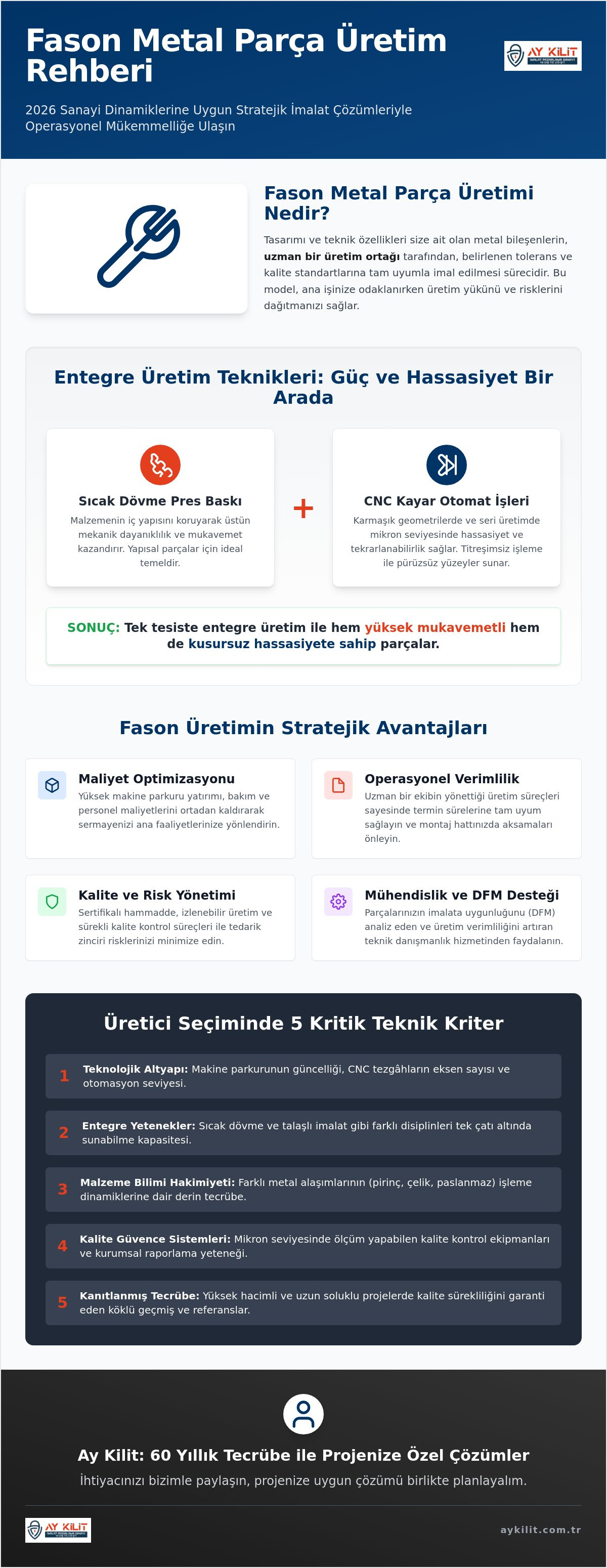
Selecting the right manufacturing partner should never be based solely on unit price. In contract metal parts manufacturing, the technical capabilities of the selected manufacturer directly affect component performance, service life, and your brand’s reputation in the market. Modern industrial requirements expect manufacturers not only to produce parts but also to provide engineering-level solutions. The technological capabilities of the machine park and the number of available CNC axes are therefore fundamental considerations for machining complex geometries. Multi-axis machines reduce the number of setups and can minimize dimensional deviations caused by repeated repositioning.
The second critical factor is Design for Manufacturability (DFM) analysis. A professional manufacturer should do more than calculate a price after reviewing your technical drawing; it should also identify potential design changes that could improve manufacturing efficiency. This engineering support can prevent recurring problems during serial production. In addition, end-to-end traceability from raw material to shipment through ERP or comparable production management systems demonstrates strong corporate reporting capability. Quality-control protocols supported by appropriate dimensional inspection equipment help verify that delivered parts remain within the tolerances specified in the technical drawing.
Quality Certification and Standards
ISO 9001 quality management principles provide an internationally recognized framework for manufacturing process discipline. In 2026, environmental performance, energy efficiency, emissions, resource use, and green transformation requirements are also becoming increasingly important in metal production and processing. Raw-material analysis reports and material certificates help verify chemical composition and traceability. Such documentation is particularly important for components requiring high mechanical strength. Post-production processes such as powder coating, plating, surface treatment, and assembly capabilities can further simplify the supply chain by consolidating multiple operations with a single manufacturing partner.
Technical Drawing and Prototype Approval Process
The success of serial production depends heavily on the rigor of the prototype stage. A small design issue overlooked during development can result in thousands of non-conforming components during mass production. A sample approval protocol provides formal confirmation that both parties agree on technical expectations. Special tolerance requirements should be clearly defined on the technical drawing, and the manufacturer must possess the process capability and machine precision necessary to maintain them consistently. To analyze your project according to these criteria, you can consult our technical team and have your project evaluated.
Ay Kilit: Project-Specific Metal Parts Solutions with Over 60 Years of Experience
Continuity and trust in industrial manufacturing can only be built through an established production culture. Since 1964, Ay Kilit has combined decades of metalworking experience with modern engineering practices to meet contemporary industrial requirements. By combining traditional materials expertise with modern CNC machinery, our company positions itself not simply as a supplier in contract metal parts manufacturing, but as a strategic manufacturing partner. More than six decades of experience provide a strong foundation for manufacturing components according to technical drawings and defined quality requirements.
Our expertise in locks and security systems, where precision manufacturing is essential, also shapes our contract manufacturing operations. The production discipline developed through complex cylinder systems and precision master key components is transferred to industrial spare parts and component projects requiring tight dimensional control. Bringing critical processes such as hot forging, CNC sliding headstock automatic machining, and powder coating services under one roof helps maintain quality consistency throughout the project.
Why Work with Ay Kilit?
Selecting a reliable partner for your production line is an important part of managing operational risk. Key capabilities offered by Ay Kilit include:
- Local Manufacturing: Production carried out at our Istanbul-based facility reduces dependence on international supply chains and supports faster logistics.
- Technical Communication: Engineering-oriented communication allows us to analyze requirements accurately and identify potential technical issues before production begins.
- Broad Manufacturing Capability: Our metalworking experience supports the production of components for a range of industrial applications, subject to project requirements and technical feasibility.
- Integrated Solutions: Managing processes from hot forging to CNC finishing under one roof can provide both time and cost advantages.
Project-Specific Planning and Communication
Every new project begins with detailed technical evaluation and planning. Your technical drawings are reviewed by our specialist team to determine the most appropriate and efficient manufacturing method for the intended application. At this stage, factors ranging from material strength requirements to surface roughness values are evaluated. Our objective is not simply to manufacture a component, but to provide durable and cost-effective solutions designed to perform reliably on your assembly line.
With our focus on sustainable quality and structured reporting, we work to maintain consistent production standards even across high-volume orders. By applying disciplined quality-management practices, we help strengthen your company’s technical competitiveness under the increasingly demanding global conditions of 2026. Share your requirements with us and let us use more than 60 years of manufacturing experience to identify the right solution for your project. To discuss technical details and request a quotation, you can reach us through our contact page.
Take Strategic Steps Toward Excellence in Industrial Manufacturing
The industrial landscape of 2026 requires more than simple component procurement; it demands an ecosystem managed through engineering discipline. As detailed throughout this guide, micron-level precision and integrated manufacturing techniques in contract metal parts manufacturing are key factors affecting your company’s competitiveness. Combining the mechanical strength of hot forging with the speed and precision of CNC sliding headstock automatic machining under one roof can improve operational efficiency while reducing uncertainty throughout the supply chain.
Ay Kilit brings manufacturing experience dating back to 1964 to projects through disciplined quality-control practices and integrated production capabilities. Within our forging and CNC machining operations, components are managed using modern engineering principles and structured production processes. Technical consultancy covering areas from materials selection to surface treatment helps minimize manufacturing risks and optimize costs. By combining technical precision with decades of manufacturing expertise, we continue to serve industrial businesses as a reliable production partner.
Share your requirements with us, and let us plan the right solution for your project together. Our production capabilities are ready to support your project with disciplined engineering and a strong commitment to quality.
Frequently Asked Questions
Which metals can be processed in contract metal parts manufacturing?
Brass, carbon steel, stainless steel, and aluminum alloys are among the most commonly processed materials in contract metal parts manufacturing. Material hardness and chemical composition directly influence CNC machining parameters and forging temperatures. Appropriate cutting tools, process parameters, and die technologies are selected according to the characteristics of each material to achieve the required surface quality. Material selection should be optimized according to the corrosion resistance, mechanical strength, and environmental conditions required by the application.
What level of precision can CNC sliding headstock automatic machining achieve?
CNC sliding headstock automatic technology can support very tight tolerances thanks to its guide bushing system. Depending on component geometry, dimensions, material, machine condition, tooling, and process capability, tolerances in the range of ±0.005 mm may be achievable for suitable features. The guide bushing helps control vibration and deflection, particularly in long and slender components, supporting dimensional stability throughout serial production. Multi-axis machines can also process complex details in fewer setups, reducing cumulative positioning errors.
How is the minimum order quantity (MOQ) determined in contract manufacturing?
The minimum order quantity (MOQ) is determined on a project basis by considering machine setup times, raw-material procurement quantities, tooling requirements, die costs, and production cycle times. High-volume serial production generally reduces unit costs, while low-volume requirements during the prototype stage may be evaluated separately. A production-efficiency analysis can be used to determine the most economical manufacturing volume for your business. The objective is to create a sustainable cost structure that supports long-term cooperation.
Can you manufacture from a physical sample if I do not have a technical drawing?
When no technical drawing is available, manufacturing from an existing sample may be possible through reverse-engineering methods. The sample can be dimensionally inspected and converted into a digital technical drawing or CAD model. Following Design for Manufacturability (DFM) analysis, the resulting data can be used to prepare a controlled manufacturing process. This approach is particularly useful when reproducing obsolete or difficult-to-source spare parts.
Can hot-forged parts be machined on CNC equipment?
Yes. Machining hot-forged blanks on CNC equipment is not only possible but is commonly used when tight dimensional tolerances or specific surface finishes are required. Forging provides the component with its basic geometry and mechanical properties, while CNC finishing creates precise dimensions, holes, threads, sealing surfaces, and other detailed features. An integrated manufacturing structure allows both processes to be managed under a unified quality system. This method is commonly used for durable components such as lock bodies and valve parts.
Do you provide quality-control reports for manufactured parts?
Quality-control documentation can be prepared according to project requirements and agreed inspection plans. Depending on the component and specification, dimensional inspection records, material certificates, and other traceability documents may be included in the technical file. Appropriate measuring equipment is selected according to tolerance requirements and component geometry. Defining documentation requirements before production helps ensure that both parties follow the same acceptance criteria.
What is the main difference between a CNC sliding headstock automatic lathe and a fixed-head lathe?
The main difference between a CNC sliding headstock automatic lathe and a fixed-head lathe lies in how the workpiece is supported and moved during machining. In a sliding headstock machine, the bar stock moves longitudinally through a guide bushing positioned close to the cutting zone. This configuration provides strong support for long and slender components and helps reduce deflection. Fixed-head lathes generally keep the workpiece in a fixed axial position while tools perform the required movements, making them particularly effective for many shorter or larger-diameter components.
What factors affect lead times in contract manufacturing?
Lead times in contract manufacturing vary according to component geometry, order quantity, raw-material availability, tooling requirements, and current production capacity. Additional operations such as hot forging, CNC machining, heat treatment, plating, powder coating, or assembly can also affect the schedule. Detailed production planning at the beginning of the project helps establish realistic delivery dates and identify potential bottlenecks before manufacturing starts. Monitoring each operation through structured production-management processes further supports reliable delivery performance.