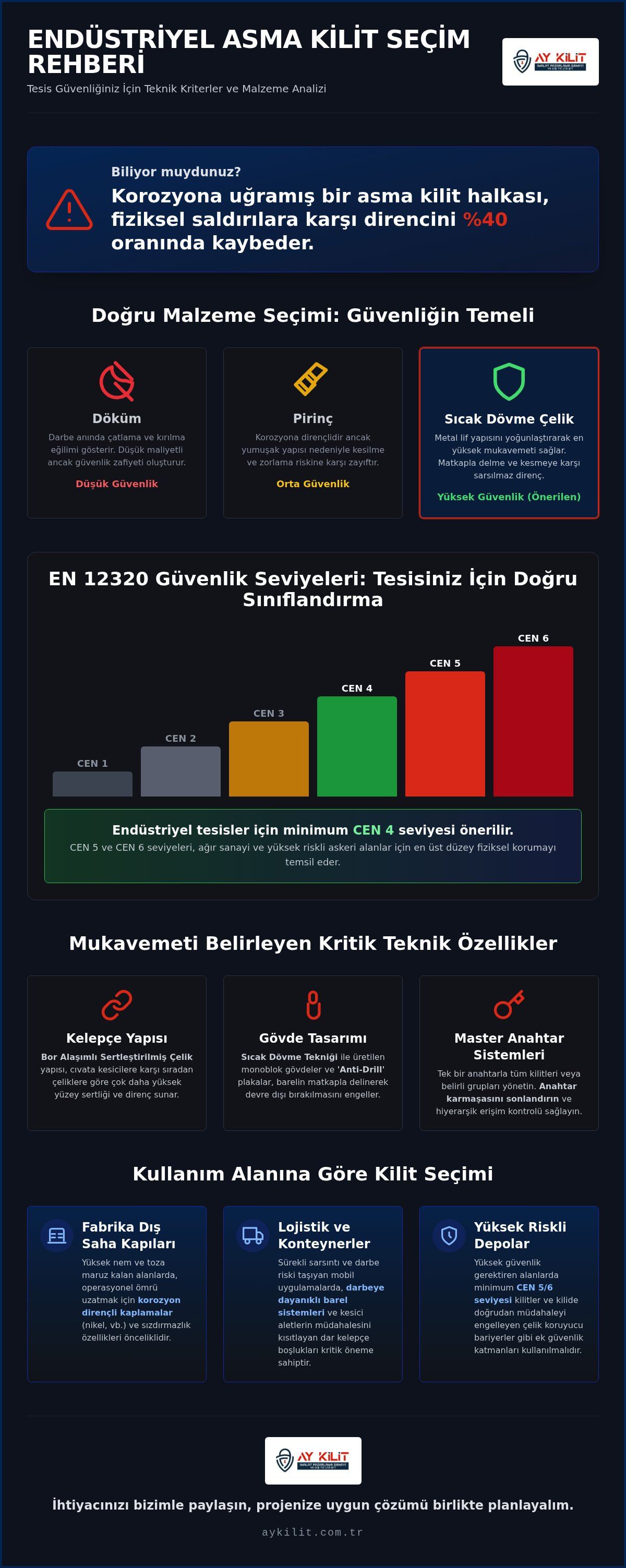
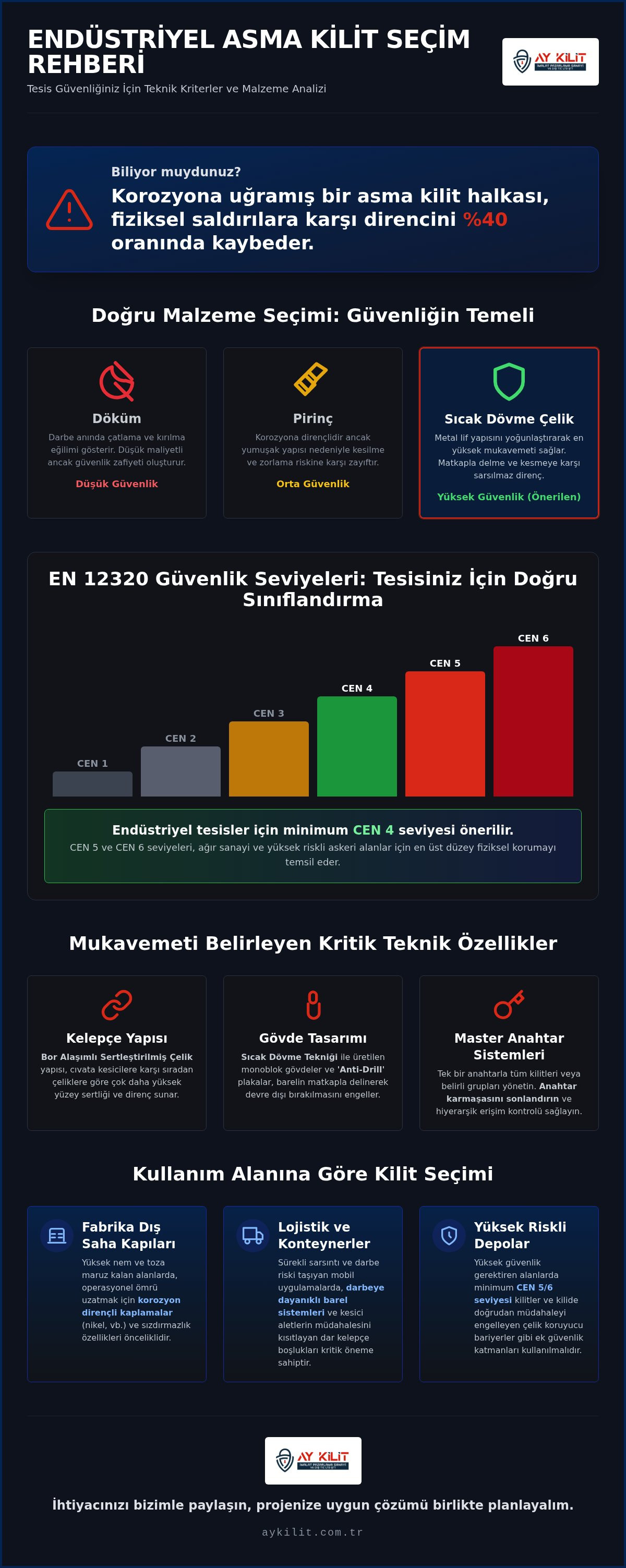
Did you know that a corroded padlock shackle can lose up to 40% of its resistance to physical attacks? In industrial facilities, frequent lock failures, key management issues, and security vulnerabilities caused by low-quality materials are not merely operational disruptions but also significant cost factors that need to be managed. As a facility manager or procurement professional, you need systems that can withstand harsh site conditions, minimize maintenance costs, and provide hierarchical access control.
In this guide, we examine the criteria for selecting the most suitable industrial padlock for your facility and the cost factors based on 2026 market dynamics from a technical perspective. From the structural advantages of hot forging and EN 12320 security standards to the operational efficiency of master key systems and raw material indices affecting steel padlock prices, you will find all the critical topics in this article. Prepared with Ay Kilit’s manufacturing discipline and engineering expertise, this comprehensive guide will help you invest in high-strength security solutions while improving operational efficiency.
Key Points
- You will discover why steel-bodied locks designed for heavy-duty industrial conditions are more durable and secure than cast products.
- You will learn the technical criteria for industrial padlock selection, including shackle diameter and cylinder technology, to improve your facility’s security level.
- You will analyze the relationship between raw material quality and manufacturing techniques that determine steel padlock prices and explore methods for achieving long-term savings.
- You will see how master key systems eliminate key management complexity and establish a hierarchical operational access structure.
- You will understand how project-specific CNC automatic machining and hot forging solutions offered by a local manufacturer can contribute to your procurement processes.
Table of Contents
What Is an Industrial Padlock and Why Should Steel Be Preferred?
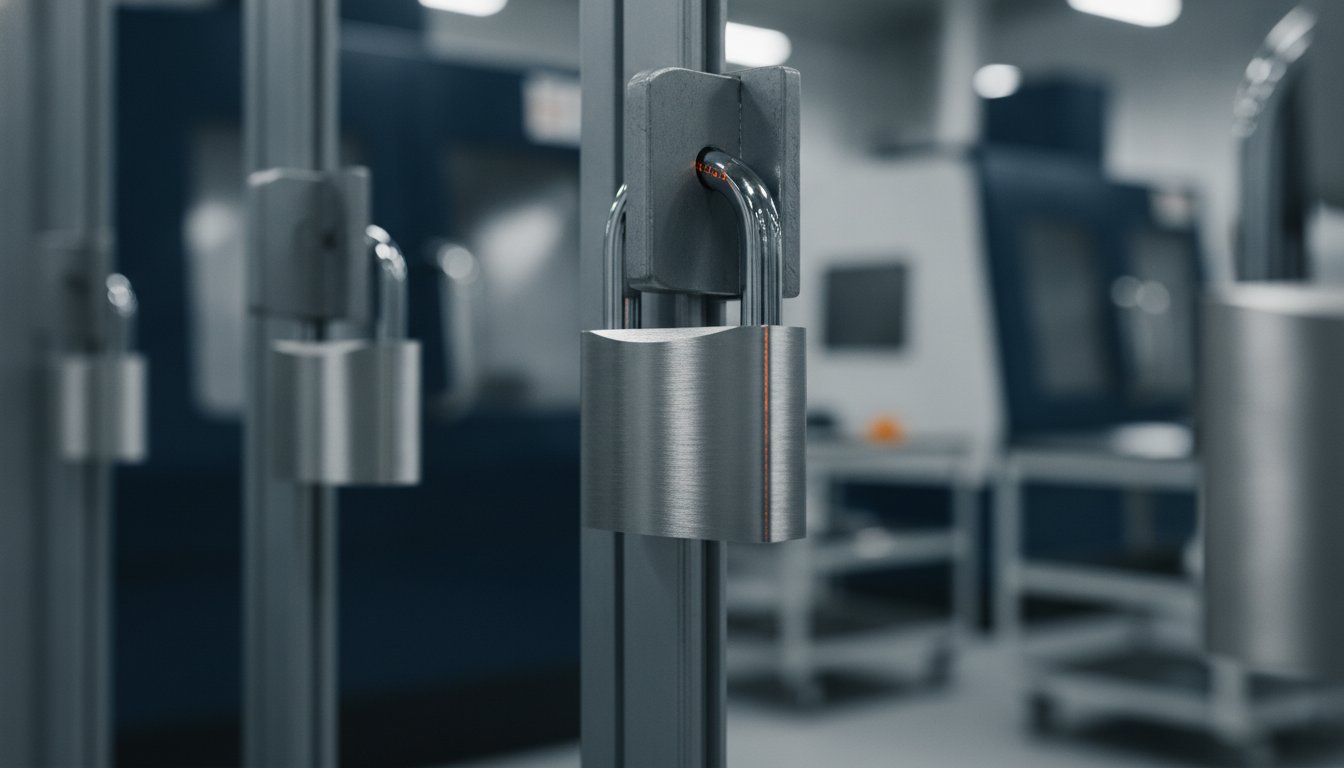
Industrial padlocks are engineering products designed to withstand heavy-duty conditions, unlike standard household locks. A lock used on an outdoor factory gate or at the main entrance of a logistics center does more than simply secure an access point; it also serves as the first line of defense against physical force, environmental corrosion, and manipulation attempts. Therefore, when making an industrial padlock selection, the molecular structure of the material and the manufacturing technique are fundamental factors determining security. For facility managers, choosing the right material directly affects not only security but also lock replacement intervals and maintenance costs.
Although brass locks are resistant to corrosion, their softer structure can make them more vulnerable to cutting. Cast bodies, on the other hand, may be more prone to cracking under impact. Steel, particularly when processed using the hot forging press techniques applied by Ay Kilit, provides high structural strength. Hot forging densifies the metal while preserving its grain flow, improving resistance to drilling and cutting attempts with large bolt cutters. According to globally recognized padlock security standards such as EN 12320, industrial locks must meet defined resistance requirements. The TSE-EN 12320:2021 standard, which remains relevant in 2026, classifies padlocks from CEN Grade 1 to CEN Grade 6. Higher-risk industrial applications generally require higher security grades based on the facility’s risk assessment.
Material Strength and Security Levels
Hardened steel shackles, particularly those manufactured from suitable alloy steels, provide increased resistance to bolt cutters and other cutting tools. The shackle is often one of the most exposed parts of a padlock. In industrial-grade padlock models, however, the shackle can be protected by the body or surrounding structures. This design limits access for cutting tools. Higher CEN security grades are intended for applications requiring increased resistance to physical attack. High-strength solutions manufactured by Ay Kilit can be configured with materials and structural designs intended to preserve integrity under demanding impact conditions.
Industrial Applications and Risk Analysis
A site-specific risk analysis is essential for selecting the correct lock. Outdoor factory gates are exposed to environmental factors such as high humidity, dust, and temperature fluctuations. In these areas, nickel plating or other protective coatings can extend the operational life of steel bodies. In logistics vehicles and containers, cylinder systems resistant to vibration and impact become particularly important. In high-risk warehouses, steel protective barriers installed around the lock can make direct physical intervention significantly more difficult, adding another layer to the overall security architecture. Share your requirements with us and let us plan the right solution for your project together.
Industrial Padlock Selection: Technical Criteria and Strength
Security in industrial facilities is too critical to be left to chance. When preparing technical specifications during procurement processes, industrial padlock selection should not be treated merely as a matter of choosing dimensions; it should be a strategic decision based on engineering data. Correctly determining the shackle diameter and clearance according to the application is the first step in physical security. For example, narrow shackle clearance may be preferred on logistics containers to restrict access for cutting tools, while wider and thicker shackles may offer practical advantages at factory entrances. Incorrect sizing can either create a physical vulnerability or prevent the lock from fitting the intended locking point properly.
Engineering Details in Shackle and Body Construction
Boron-alloy or specially hardened steel shackles can offer greater resistance than conventional untreated steel. This structure makes it considerably more difficult for bolt cutters to grip and cut the shackle. Anti-drill plates incorporated into the body design help prevent the cylinder from being disabled by drilling. At Ay Kilit, we integrate cold forging press and hot forging disciplines into our manufacturing processes to improve body integrity. For a more detailed technical analysis, you can review our High-Security Padlocks guide.
Locking Mechanism and Cylinder Technology
The cylinder system is the core mechanism determining a lock’s operational life and security. CNC sliding-head automatic machining used for precision padlock mechanisms should be performed within carefully controlled tolerances. This precision contributes to smooth operation and improves resistance to manipulation attempts such as picking. A double-ball locking mechanism secures the shackle from both sides of the body, increasing resistance to pulling and forcing compared with simpler single-sided locking designs. In dusty and contaminated industrial environments, particularly chemical facilities, a protected keyway design helps prevent contamination from interfering with the mechanism and supports operational continuity.
For outdoor applications, corrosion resistance is one of the principal factors determining the service life of a lock. Electrostatic powder coating and nickel-chrome plating can provide additional protection against harsh weather conditions. Corrosion can progressively weaken exposed metal components and impair the operation of the locking mechanism. Cylinders designed to restrict unauthorized key duplication also help maintain hierarchical security within the facility. To determine the technical configuration most appropriate for your facility’s risk analysis, you can contact our expert team. Share your requirements with us and let us plan the right solution for your project together.
Steel Padlock Prices and Cost-Determining Factors
When planning a budget for industrial facilities, focusing solely on the unit purchase price can be misleading. Steel padlock prices depend on numerous technical variables, ranging from raw material grade to the complexity of the manufacturing process. Under 2026 market conditions, fluctuations in global raw material prices, exchange rates, energy costs, manufacturing volume, and surface treatment requirements can all affect pricing. At the same time, low-cost locks that require frequent replacement or create security vulnerabilities can unexpectedly increase a facility’s total cost of ownership (TCO). Proper industrial padlock selection therefore requires balancing initial investment with long-term operational value.
Another critical factor influencing cost is resistance to environmental conditions. Electrostatic powder coating or special finishes such as nickel-chrome may initially appear to add cost, but they can reduce premature deterioration caused by corrosion. The downtime and replacement costs associated with a corroded mechanism may be considerably higher than the cost of selecting an appropriate protective finish at the outset. Working with a local manufacturer can also reduce logistics complexity and provide greater flexibility in technical support and project-specific production.
Impact of Manufacturing Methods on Price
Hot forging shapes metal at elevated temperatures while controlling its grain flow and structural integrity. Although this method requires more specialized manufacturing infrastructure than basic casting processes, it can significantly improve component strength and service life. Ay Kilit’s Hot Forging Press technology is used to manufacture lock bodies with improved structural integrity and impact resistance. CNC sliding-head machining is also used in cylinder systems, where controlled tolerances contribute to smooth operation and consistent component quality. These manufacturing processes can influence unit price while also contributing to the long-term performance of the security system.
Quantity and Project-Based Pricing Strategies
In corporate procurement, economies of scale can play an important role in reducing unit costs. For large-volume orders, optimized production planning can lower labor, setup, and energy costs per component. For contract manufacturing or project-specific requirements, pricing is influenced by design complexity, material grade, dimensions, surface treatment, cylinder configuration, and required quantities. Purchasing directly from a local manufacturer can reduce intermediary costs while facilitating faster technical communication and support. Systems designed for straightforward servicing and long operational life can also contribute to lower lifecycle costs. Share your requirements with us and let us plan the right solution for your project together.
Operational Cost Management with Master Key Systems
Security in industrial facilities is measured not only by physical strength but also by how efficiently that security is managed. In a factory with hundreds of locks, carrying a separate key for each lock creates an operational burden and can also introduce serious risks during emergencies. A professional industrial padlock selection process should therefore consider not only the physical properties of the locks but also how they will operate within an access hierarchy. Master Key Systems can optimize facility-wide access control, improve operational efficiency, and reduce the number of keys personnel need to manage.
Efficiency Advantages of Single-Key Applications
Keyed-alike lock systems allow personnel to access multiple authorized locations using a single key. This approach can save time in areas such as transformer stations, pump rooms, warehouses, and technical facilities where multiple locks are used. Reducing key complexity improves response times while lowering the risk associated with carrying and managing numerous individual keys. When additional locks or replacement keys are required, working directly with the manufacturer can simplify the process of producing compatible components for the existing system.
Hierarchical Access and Security Planning
A hierarchical structure can be configured using Grand Master, Group Master, and lower-level master key arrangements. A facility manager or security supervisor may be authorized to access the entire facility, while a department manager may only access locks within their own area of responsibility. This structure provides mechanical access control without depending on a digital infrastructure. Precision engineering of the pin arrangements within the cylinder systems is essential for ensuring that the hierarchy functions reliably. CNC sliding-head machining enables the production of components required for complex keying configurations while maintaining controlled tolerances. During emergencies, properly planned master key access can also help authorized personnel reach critical areas more quickly.
To create an access plan tailored to your facility and improve operational key management, you can benefit from our master key system planning service. Share your requirements with us and let us plan the right solution for your project together.
Project-Specific Industrial Solutions with Ay Kilit
Since 1964, Ay Kilit has been addressing industrial security requirements in Türkiye through local manufacturing. More than half a century of manufacturing experience enables us to combine traditional production expertise with modern engineering disciplines to provide industrial padlock solutions. For factories, warehouses, logistics centers, and other high-security environments, the industrial padlock selection stage is a critical process that can affect future operational efficiency. In this process, we aim to act not only as a supplier but also as a technical solution partner.
Our manufacturing infrastructure, including hot forging press capabilities and CNC-supported serial production, enables us to manufacture products for demanding industrial applications. Lock configurations can be developed according to project requirements, environmental conditions, dimensions, keying architecture, and intended security level. Our production approach focuses on controlled manufacturing processes, material quality, and consistent technical specifications.
Logistical and Technical Advantages of Local Manufacturing
Unlike standardized imported solutions, local manufacturing provides greater flexibility in responding to project-specific requirements. Flexible production planning can help reduce procurement lead times and facilitate revisions when technical specifications change. Direct communication with the manufacturer also makes it easier to clarify dimensions, materials, surface treatments, and keying requirements. With engineering support, the most suitable padlock configuration can be determined according to your facility’s physical conditions, humidity levels, usage frequency, and access requirements.
Corporate Partnership and Procurement Process
For technical procurement professionals and facility managers, one of the greatest challenges is establishing a sustainable system that complies with project specifications. Ay Kilit provides technical support during the specification and planning stages to help determine appropriate security configurations. Depending on the project, customized cylinder systems, keyed-alike lock groups, and master key architectures can be planned according to operational requirements. After-sales technical support and access to compatible replacement components also contribute to maintaining the system over the long term.
Share your requirements with us and let us plan the right solution for your project together.
Take Industrial Facility Security into the Future
Securing an industrial facility goes beyond purchasing a lock; it is an engineering process that affects operational efficiency, access management, and physical resistance. As discussed throughout this guide, forged steel bodies, appropriate protective finishes, carefully selected cylinders, and hierarchical master key systems can improve security while reducing unnecessary operational complexity. Making the right industrial padlock selection is therefore a strategic step toward sustainable facility security and operational continuity.
At Ay Kilit, we combine our manufacturing experience dating back to 1964 with hot forging, CNC machining, and project-specific keying solutions. Through master key systems and configurable industrial padlocks, we develop access structures tailored to the operational requirements of facilities. The technical flexibility and procurement advantages of direct manufacturing can help turn security investments into sustainable long-term solutions.
Share your requirements with us and let us plan the right solution for your project together.
Frequently Asked Questions
What is the most important technical criterion when selecting an industrial padlock?
The most important criterion is matching the lock’s security performance to the risk level of the application. When making an industrial padlock selection, body material strength, shackle resistance, locking mechanism design, corrosion resistance, and relevant EN 12320 classification should all be evaluated together. Higher-risk industrial applications generally require locks with higher resistance classifications and more robust physical protection.
Why do steel padlock prices vary in 2026?
Steel padlock prices in 2026 vary according to raw material costs, steel grade, energy expenses, exchange rates, manufacturing method, surface treatment, cylinder complexity, order quantity, and project-specific requirements. Hot forging and precision CNC machining can increase manufacturing complexity but may also contribute to higher structural durability and more consistent operation. Local production can provide additional advantages in logistics, technical support, and project-specific procurement.
Which type of lock should I choose for outdoor environments to prevent corrosion?
For outdoor environments, locks with suitable corrosion-resistant materials and protective surface treatments should be preferred. Depending on the environment, nickel-plated steel, stainless components, brass bodies, or specially coated surfaces may be appropriate. In coastal, humid, or chemically aggressive environments, the specific corrosion exposure should be evaluated before selecting the material and coating system.
Can a master key system be applied to existing padlocks?
A master key system cannot necessarily be retrofitted to every padlock. The lock must have a cylinder architecture compatible with master keying. If hierarchical access control is required throughout the facility, industrial padlock selection should ideally be made from models designed to support the planned master key structure from the beginning of the project.
What is the difference between hot-forged steel padlocks and cast locks?
Hot forging and casting use fundamentally different manufacturing processes. Forging shapes metal under pressure and can produce favorable grain flow and structural properties, while casting forms the component by pouring molten metal into a mold. Actual resistance to impact, cutting, drilling, or fracture depends on the alloy, heat treatment, component geometry, manufacturing quality, and final design rather than the production method alone.
What size padlock should I choose for my facility?
The appropriate lock size depends on the dimensions of the hasp, chain, gate, or equipment being secured. Body width alone should not determine the choice. Shackle diameter, shackle clearance, material, locking mechanism, exposure to cutting tools, and compatibility with the locking point are more important technical considerations. Measurements should therefore be taken directly from the application before procurement.
How should padlocks be maintained in industrial facilities?
Industrial padlocks should be periodically inspected for corrosion, contamination, wear, and mechanical damage. The appropriate lubricant should be selected according to the manufacturer’s recommendations and the operating environment. In dusty environments, lubricants that attract and retain contaminants should be avoided. Maintenance frequency should be determined according to usage intensity, environmental exposure, and the manufacturer’s service instructions.
Which quality standards apply to locally manufactured padlocks?
The relevant performance standard for padlocks in Europe is EN 12320. However, not every locally manufactured padlock is automatically certified to the same security grade. During procurement, buyers should verify the specific model’s test reports, declared EN 12320 classification, material specifications, corrosion performance, and manufacturer documentation rather than relying solely on the product’s country of manufacture.