In industrial manufacturing, the difference between project sustainability and operational failure is determined not only by whether a component takes the desired form, but also by whether it gains unwavering strength at the molecular level. Particularly in critical industries, the unexpected failure of low-quality cast components or the high-cost machining processes required to produce complex geometries represent serious risk factors for many facility managers. At Ay Kilit, with our deep-rooted experience in metal forming since 1964, we explain with technical data how hot forging press technology eliminates these challenges.
As you know, achieving the right balance between the need for high-strength components and cost optimization is one of the greatest priorities of modern engineering. In this guide, you will discover the technical details of the hot forging press process, its industrial advantages, and the most efficient application methods for your projects. In the following sections, we will examine critical topics from the cost dynamics of the metal industry as of 2026 and Industry 4.0 integration to methods that minimize material waste in complex components and CNC-supported mass production capacity. Let us analyze together how the right manufacturing methodology can take your operational efficiency to the next level.
Key Points
- You will learn how the hot forging process improves the internal structure of metal and why it provides superior strength compared to cast components.
- You will examine how production stages requiring technical precision, from raw material cutting to controlled heating, contribute to operational efficiency.
- You will discover when the hot forging press method is the right choice for optimizing the balance between cost and performance in your projects.
- You will analyze modern methods that prevent material waste and reduce the machining workload in the production of components with complex geometries.
- You will evaluate Ay Kilit’s CNC-supported mass production and project-specific manufacturing capabilities, backed by engineering expertise dating back to 1964.
Contents
What Is Hot Forging Press Forming? Industrial Definition and Fundamental Principles
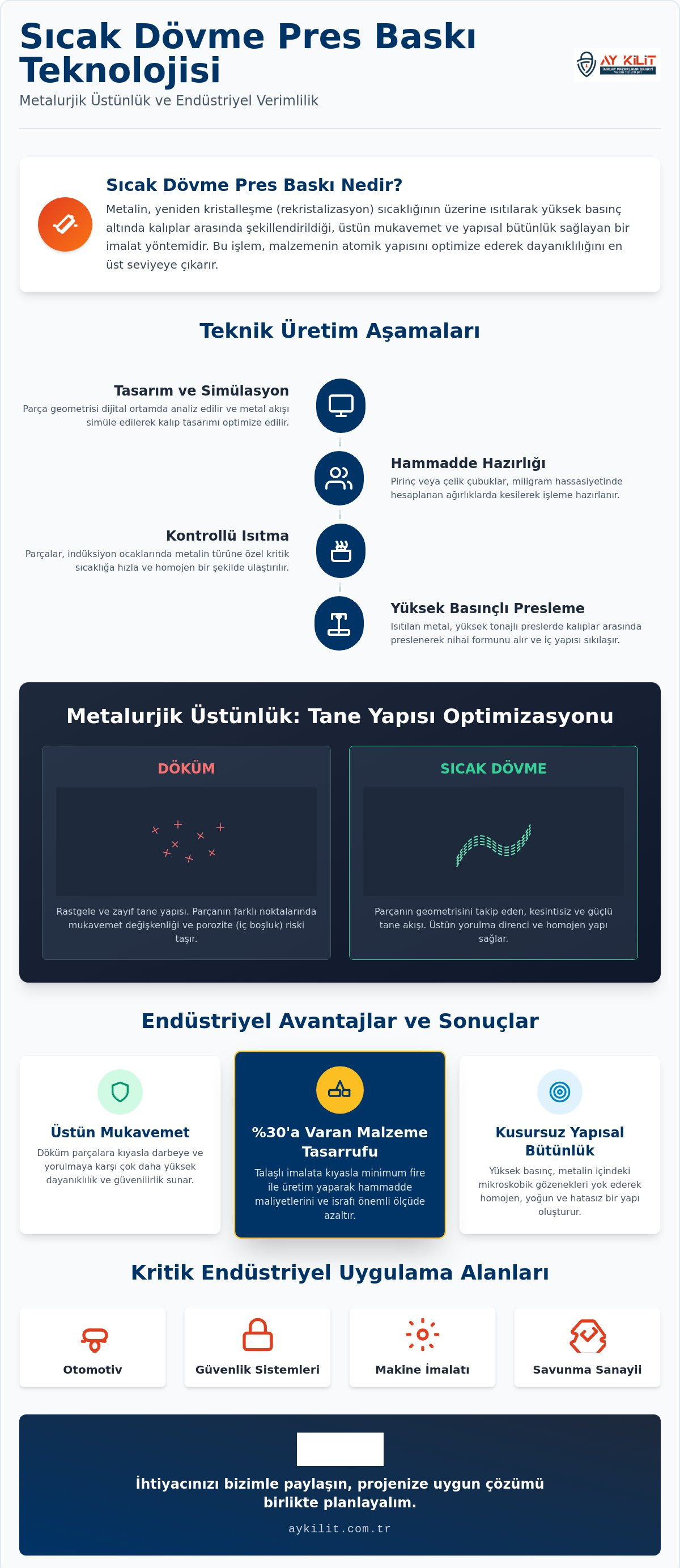
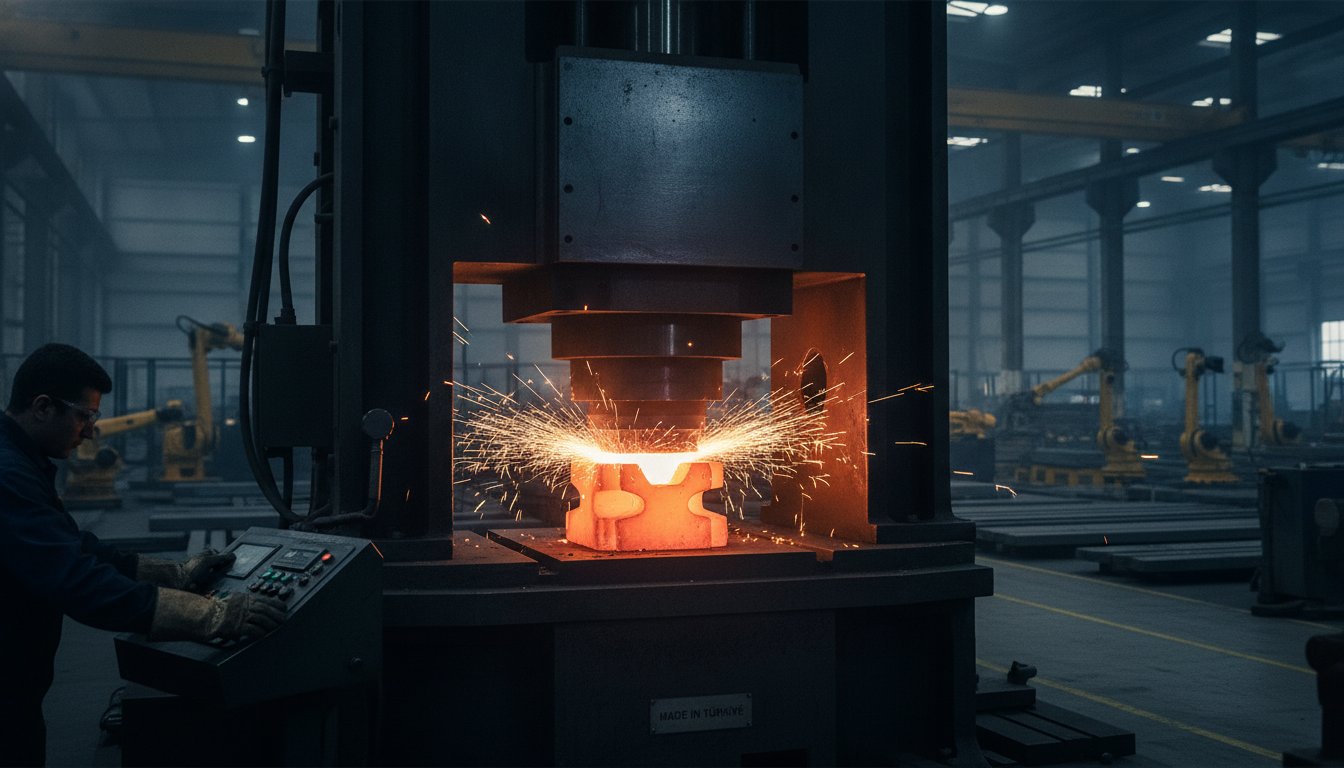
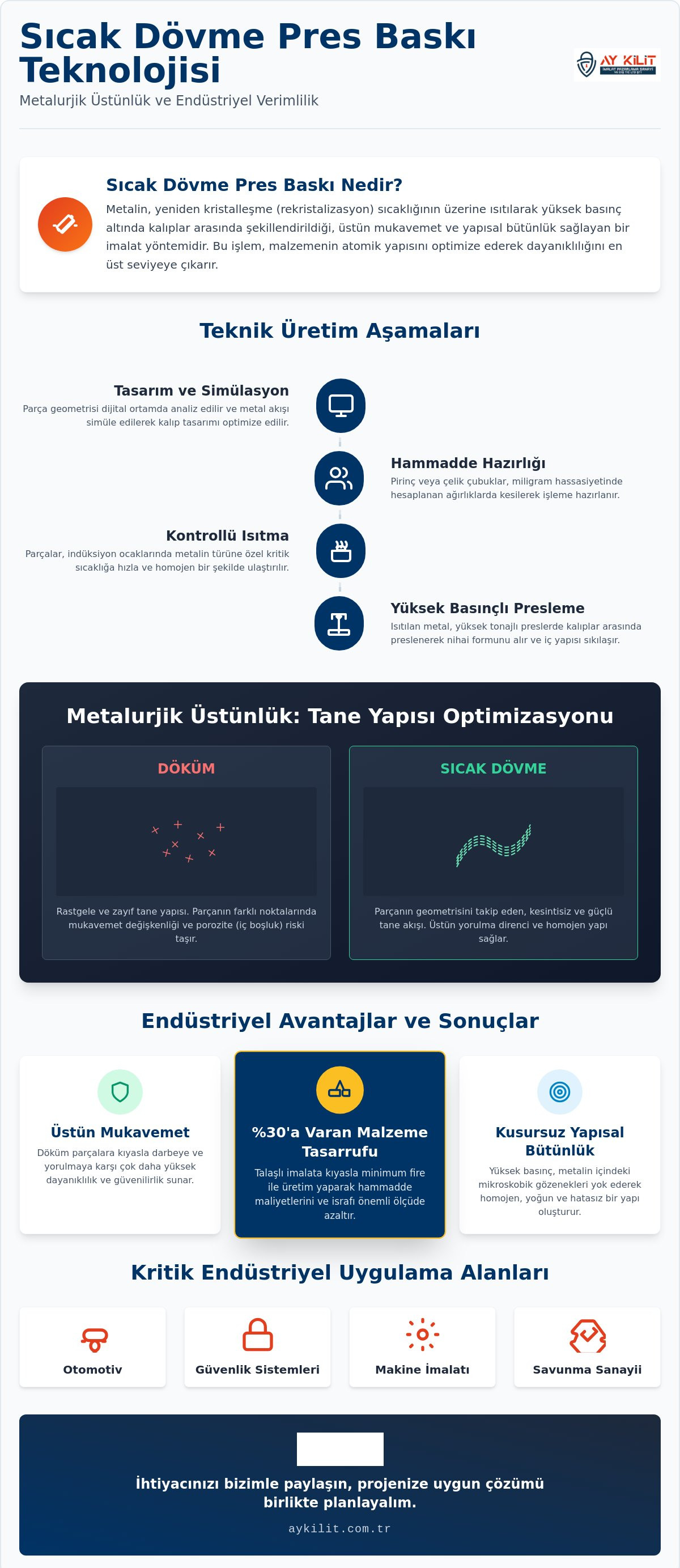
In the process of giving metal its industrial form, hot forging press forming is a critical method that optimizes not only the external appearance of the material but also its atomic arrangement. The process begins by heating the metal above its recrystallization temperature. In light of basic information about the forging process, this high temperature brings the metal’s plastic deformation capability to its peak. As a result, the pressing force required to shape the component decreases, the risk of material cracking is eliminated, and the mechanical load on the dies is reduced, increasing operational efficiency.
In modern production lines, metals such as brass, steel, and aluminum alloys are among the most common materials used with this method. Internal voids, or porosity problems, which are frequently encountered in casting and create weak points in components, are eliminated by the high pressure applied during hot forging. The hot forging press forming technique shapes the metal not by cutting it, as in machining, but by directing it in a controlled flow, thereby preserving the structural integrity of the component at the highest level. At Ay Kilit’s production facilities, this process is managed with technical precision to produce components that meet demanding industrial standards.
The Metallurgical Importance of Hot Forging
From a metallurgical perspective, forging reorganizes the grain structure of the material. While crystals are randomly distributed in casting, the grain flow direction is aligned with the geometry of the component during the hot forging process. This significantly increases the component’s fatigue resistance against dynamic loads and sudden impacts. The high pressure generated during the process compresses microscopic pores within the metal, creating a homogeneous structure. As a result, exceptional durability is achieved, particularly in safety-critical components such as locking systems and automotive parts.
Why Should Hot Forging Be Preferred?
Hot forging offers exceptional efficiency, particularly in the mass production of components with complex geometries. While a significant portion of the material used in machining is removed as chips and becomes scrap, hot forging can reduce this waste by up to 30%. This creates a significant competitive advantage for manufacturers under the fluctuating raw material costs of the 2026 market. At Ay Kilit, we use this method in many critical components, from padlock bodies to high-security cylinder components, providing material savings while optimizing unit costs in high-volume production.
Technical Stages of the Hot Forging Process: From Design to Finished Component
The forging process begins with the digital analysis of the technical drawing and simulation of the component geometry. At Ay Kilit, during the raw material preparation stage, we calculate the weight of brass or steel bars with milligram-level precision. This meticulous approach both prevents material waste and ensures dimensional accuracy by completely filling the die cavity. The cut pieces are then transferred to induction furnaces or controlled furnaces to reach the critical temperature determined according to the type of metal. Heating reduces the metal’s resistance to plastic deformation, allowing the material to penetrate the finest details of the die during press forming.
Precision Die Design and Engineering
Die design is one of the most important engineering disciplines directly affecting hot forging press quality. During the design stage, the metal flow paths within the die are simulated using advanced software to minimize the margin of error. High-alloy hot-work tool steels used to extend die life undergo specialized heat treatment processes. This professional approach ensures that components remain within the tolerance values specified in the technical drawing even after thousands of pressing cycles. You can contact our technical team to obtain more information about our die processes for your custom projects.
Thermal Control and Temperature Management
The forging temperature must be maintained within a narrow range to prevent deterioration of the metal’s internal structure. The U.S. Department of Energy forging report emphasizes how precise temperature management in industrial forging facilities directly affects component durability and energy efficiency. Oxidation and scale that may form during heating can reduce surface quality. To manage this risk, controlled-atmosphere heating technologies are used at Ay Kilit facilities. Controlled cooling or annealing processes applied after forging bring the component’s hardness and toughness balance to its final level.
During the press forming stage, the heated raw material takes its designed form under high-tonnage presses. Once the hot forging press forming process is completed, the excess metal formed around the component, known as flash, is rapidly removed using special trimming dies. In the final stage, sandblasting or vibratory surface cleaning processes are applied to remove heat treatment marks from the surface and provide the component with a smooth texture. Our integrated production line manages each of these processes in-house without compromising technical discipline.
Differences Between Hot and Cold Forging: Which Method Should Be Preferred and When?
One of the most critical decisions in industrial component design is determining the temperature regime under which the material should be formed. Because the hot forging press forming process is carried out above the metal’s recrystallization temperature, the material’s flow resistance is minimized. This provides exceptional advantages, particularly in the production of complex and high-volume components such as lock bodies. Cold forging, on the other hand, is performed at room temperature and operates on the principle of strain hardening. Although both methods offer distinct advantages, the selection criteria depend on the technical requirements of the project.
From a cost analysis perspective, hot forging requires additional energy consumption to heat the raw material. However, as component complexity increases, this cost is offset by the material and time savings achieved compared to machining. Cold forging consumes less heating energy, but the higher forming forces involved can increase die loading and wear depending on the material and geometry. At Ay Kilit, our expertise in both manufacturing disciplines enables us to determine the most economical and technically efficient method for your projects.
Selection Criteria According to Application
Hot forging is highly advantageous for heavy industrial components, large valves, and high-security padlock bodies that require exceptional durability. The grain flow within the metal adapting to the component geometry increases the impact resistance of these components. Cold forging, on the other hand, is preferred for smaller, symmetrical components requiring very tight dimensional tolerances. To better understand the solution you need, you can review our Cold Forging Manufacturing guide and examine the differences between the two methods in greater detail.
Economic and Technical Efficiency Comparison
The relationship between investment costs and production volumes is a determining factor in method selection. Hot forging press forming may offer advantageous die life in suitable applications because the material has lower flow stress at elevated temperatures, although actual die life depends on factors such as alloy, temperature, lubrication, geometry, and process control. This can provide a mass-production advantage, particularly in periods such as 2026 when raw material and operational costs are highly sensitive. Cold forging, meanwhile, can minimize the need for secondary operations such as CNC contract manufacturing by providing high dimensional accuracy and surface quality directly after forming.
In terms of production speed, hot forging increases efficiency for large and difficult components, while cold forging can produce standard components in very short cycle times. At Ay Kilit’s modern production facility, the material’s machinability and the hardness values expected from the final component are analyzed to create a sustainable production plan. Choosing the right method directly affects not only component quality but also the operational profitability of your business.
Industrial Applications and Advantages of Hot-Forged Components
Hot forging press forming technology is a cornerstone of critical industries where materials must retain their structural form even under the most demanding conditions. Components produced using this method offer excellent impact and fatigue performance compared with many conventional cast alternatives. The operational continuity of industrial facilities is directly linked to the fatigue resistance of the components used. At Ay Kilit, we integrate the strength provided by this technology into the technical requirements of different industries, supported by expertise dating back to 1964.
The sectors that benefit from these advantages can be summarized as follows:
- Automotive Industry: Forging technology is used in components exposed to intense dynamic loads, such as drivetrain components, tie rod ends, and suspension parts.
- Plumbing and Valve Systems: Forged brass bodies provide sealing performance and crack resistance in high-pressure fluid systems.
- Defense Industry: It is preferred in the production of critical mechanical components where low weight and exceptional durability are required simultaneously.
- Locks and Security: High-security padlock bodies and cylinder components gain enhanced resistance against external impacts through this method.
Brass Hot Forging and the Lock Industry
In security systems, the corrosion resistance of brass and the dense structure achieved through hot forging press forming directly influence product service life. In mechanisms requiring high precision, such as master key systems, the exact fit between components and resistance to wear are critical. The forging process consolidates the material structure and provides a strong, reliable foundation for cylinder systems. As a result, locks can maintain smooth operation even after years of intensive use.
Operational Advantages and Efficiency
In modern manufacturing processes, the “near-net shape” principle is crucial for cost optimization. Hot forging allows complex forms to be produced with minimal material removal. This not only facilitates assembly but also minimizes raw material waste. You can review our Contract Metal Component Manufacturing processes for custom metal components and obtain more detailed information about our technical capabilities.
Hot-forged components can provide high strength with optimized wall sections compared with many cast alternatives. This can reduce the overall weight of the final product without compromising safety when the component is properly engineered. This durability difference is particularly noticeable in heavy-duty locks used in industrial facility security management. For the technical details and capacity planning required for your project, request technical support for your project and benefit from our expertise.
Project-Specific Hot Forging and Contract Manufacturing Solutions with Ay Kilit
Since 1964, Ay Kilit has combined its extensive engineering expertise in metal forming with modern manufacturing technologies. Our hot forging press forming capability plays a central role not only in manufacturing our own locking systems but also in the contract manufacturing solutions we provide to different industries. Production based on technical drawings or samples supplied by our customers is managed to meet specified dimensional requirements and demanding industrial standards. We combine the meticulous approach of traditional craftsmanship with the discipline of CNC-supported mass production to deliver consistent quality in every component.
Our production line provides a fully integrated structure extending beyond the forging process. Following hot forging press forming, we use our CNC sliding-head machining and CNC contract manufacturing capabilities for components requiring precision finishing. In addition, for projects requiring corrosion resistance and an aesthetic appearance, our electrostatic powder coating service enables components to be delivered ready for final assembly. This end-to-end production discipline reduces supply chain complexity while providing customers with operational speed and cost advantages. We manage every stage, from design to shipment, through a transparent and technically focused process.
Why Should You Choose Ay Kilit?
Our industrial identity combines the strength of domestic manufacturing with international quality expectations. Our commitment to on-time delivery and sustainable supply chain management positions us not merely as a supplier but as a reliable solution partner. Our experience across industries ranging from automotive to locking systems demonstrates our expertise in overcoming the unique technical challenges of each project. Through modern engineering practices, we achieve an optimized balance between minimum material waste and maximum required strength, even in complex geometries.
Contact and Project Planning
Our technical consultancy service for custom projects identifies potential design issues before production begins, helping prevent unnecessary costs. With rapid quotation and sample production processes, we work in line with your project schedule. Our technical team analyzes your project requirements and determines the most efficient production method together with you. This professional approach, developed for factories, industrial facilities, and logistics centers, is focused on operational excellence.
Share your requirements with us, and let us plan the right solution for your project together.
Optimize Strength and Efficiency in Industrial Manufacturing
Hot forging press forming technology enhances not only the shape of the metal but also its internal structure, delivering exceptional durability under demanding operating conditions. As examined throughout this guide, correct temperature management and precision die design provide components with high fatigue resistance under dynamic loads. Drawing on our industrial experience since 1964, we combine these technical advantages with the discipline of CNC-supported mass production. With our domestic manufacturing capabilities and commitment to high strength, we help reduce material waste while producing contract-manufactured components in accordance with specified technical drawings.
Thanks to our modern engineering approaches and precision CNC integration, you can bring complex components to life with high production efficiency. At Ay Kilit, we provide transparent, solution-oriented guidance at every stage with our industrial manufacturing expertise. You can contact our technical team to improve your operational performance without compromising quality standards. We help you build the future of your business on solid foundations with the right manufacturing methodology.
Share your requirements with us, and let us plan the right solution for your project together.
Frequently Asked Questions
Which materials are most suitable for hot forging press forming?
Hot forging press forming is highly effective for metals such as brass, steel alloys, aluminum, and copper that offer suitable plastic deformation characteristics at elevated temperatures. At Ay Kilit, our expertise particularly in brass and metal forging enables these materials to take the die form efficiently at high temperatures. Components produced using this method provide excellent results in critical applications such as cylinder systems and valve bodies that require high toughness and reliable sealing performance.
What is the difference between hot forging and casting?
The fundamental difference between forging and casting lies in the manufacturing route and resulting material structure. In casting, molten metal is poured into a mold, while in hot forging press forming, solid material heated to the appropriate forging temperature is shaped under high pressure. Forging can close internal voids and refine the material structure, providing excellent impact resistance and structural integrity compared with many cast alternatives.
What is the minimum order quantity for hot-forged components?
Minimum order quantities are determined on a project basis according to the component weight, geometric complexity, and required press tonnage. At our facility, which operates with a mass-production discipline, we generally focus on high-volume projects to optimize operational costs and die setup processes. You can contact our technical team directly for the feasibility assessment and quantity planning of your specific project.
How are die costs calculated for hot forging?
Die costs are calculated according to the design details of the component, the quality of the hot-work tool steel to be used, and the targeted total die life. Components with complex forms may require more advanced engineering and simulation studies, which can affect the initial investment cost. However, in high-volume mass production, die costs are distributed across the number of components produced, providing a significant long-term economic advantage.
Is heat treatment required after hot forging?
The need for heat treatment varies according to the mechanical properties, hardness, and stress requirements specified for the component. Some steel alloy components may require post-forging stress relief, normalizing, quenching, tempering, or other heat treatments, while brass components may require different post-processing depending on alloy and application. At Ay Kilit, we carefully plan the most appropriate metallurgical process according to the component’s intended use.
How corrosion-resistant is hot-forged brass?
Hot-forged brass components benefit primarily from the inherent corrosion resistance of the selected brass alloy. The forging process can improve structural soundness by reducing internal defects, while actual corrosion performance depends on alloy composition, environment, surface condition, and any applied coating. This makes properly selected and manufactured brass particularly suitable for applications such as outdoor padlock bodies.
What is the surface quality of hot-forged components?
The hot forging process can produce components in a “near-net shape,” reducing the amount of subsequent machining required. Heat-related surface scale and process marks formed after press forging can be removed using methods such as blasting or vibratory finishing. For areas requiring tighter tolerances and higher dimensional precision, we bring the component to its final dimensions using our CNC contract manufacturing capabilities.
Does Ay Kilit accept external contract hot forging projects?
Yes, drawing on our manufacturing experience since 1964, Ay Kilit provides professional solutions for external contract hot forging requirements. We manage the entire process in-house, from die design to mass production, based on technical drawings or samples provided by our customers. We manufacture high-strength contract metal components for various industries, including automotive, defense, and construction.