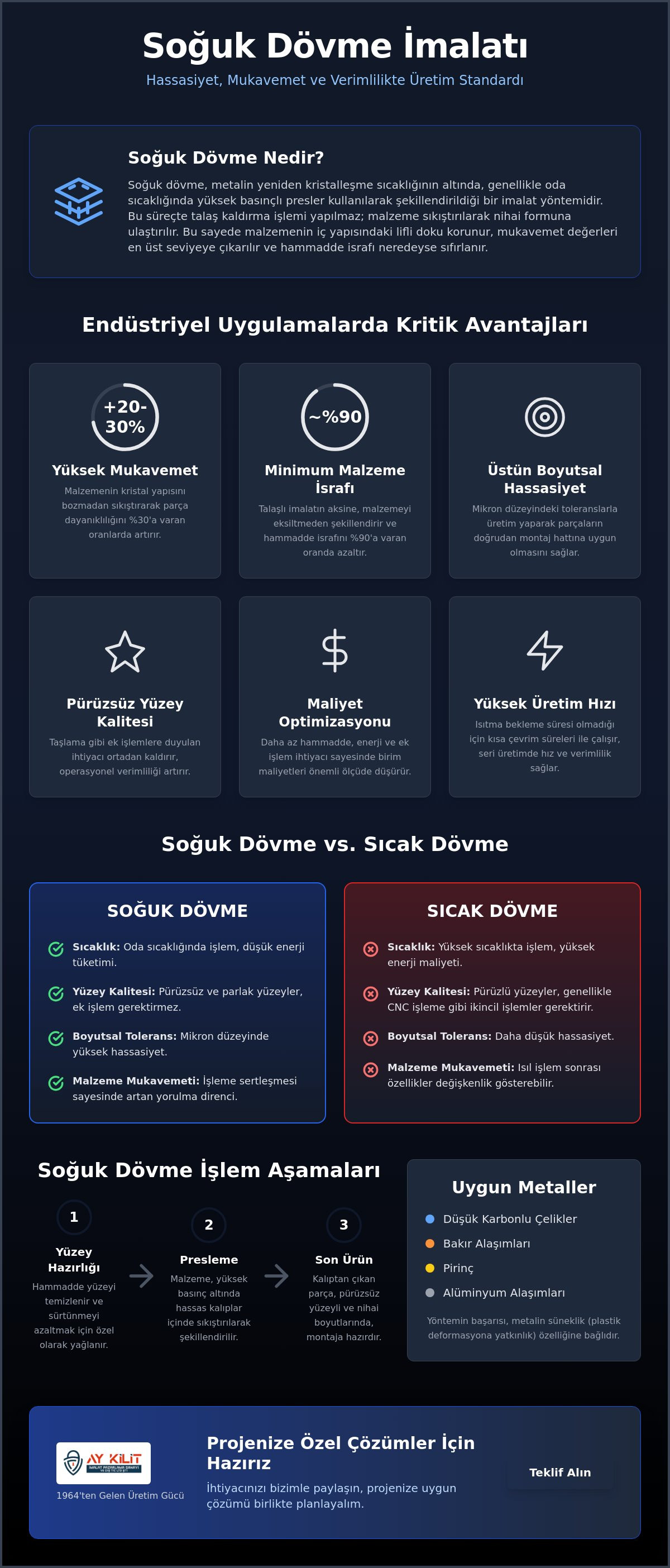
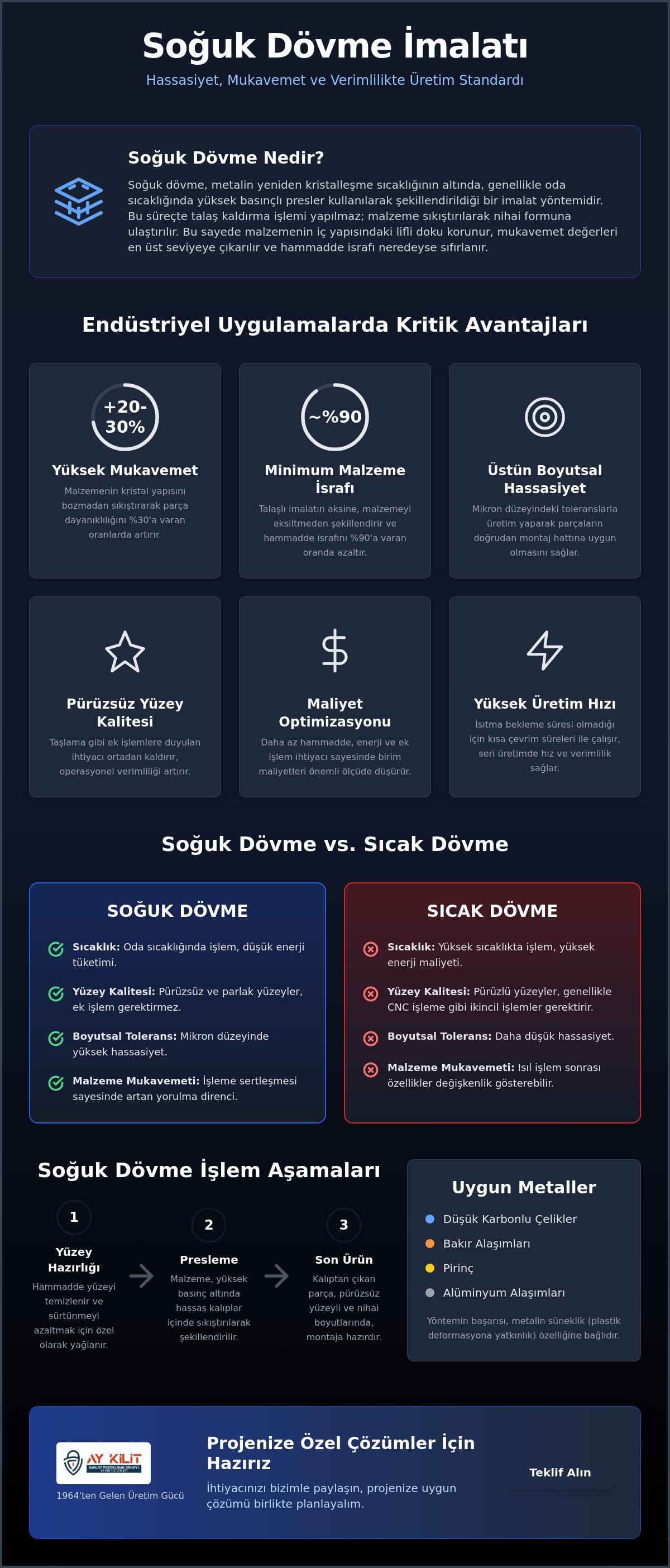
Every gram of material lost and every incorrect tolerance in industrial production processes represents a direct compromise on profitability. The high waste costs of machining or the dimensional deviations caused by hot forging can become operational burdens in mass production. Cold forging manufacturing is a strategic engineering method that shapes metal at room temperature without disrupting its crystalline structure, increasing part strength by 20% to 30% while minimizing material waste.
Producing highly durable parts and optimizing unit costs is a necessity in today’s competitive industrial environment. In this article, you will discover how cold forging techniques maintain precise tolerances, reduce the need for secondary processes such as grinding, and how Ay Kilit manages this process with a production discipline dating back to 1964. We will also examine how our modern CNC-supported infrastructure and extensive engineering experience respond to your industrial solution requirements, together with technical details that improve operational efficiency.
Key Points
- You will understand the principles of high strength and work hardening achieved by shaping metal at room temperature.
- You will learn the technical details that minimize the need for secondary processing thanks to micron-level dimensional precision.
- You will discover how to optimize production costs by reducing raw material waste by up to 90% with cold forging manufacturing.
- You will see how smooth surface quality extends the operational life of critical components such as gears and shafts operating under high torque.
- You will examine the corporate assurance that Ay Kilit’s modern press forming capabilities, combined with more than half a century of expertise, bring to your projects.
Table of Contents
What Is Cold Forging Manufacturing? Basic Principles and Definition
One of the most advanced methods combining precision and durability in the world of metal forming, cold forging manufacturing is the process of permanently deforming metal below its recrystallization temperature, generally at room temperature. The basic principles of cold forging aim to give the part its final form without removing any material by taking advantage of the plastic flow characteristics of the material. This approach brings material waste close to zero in industrial production while preserving the fibrous structure within the part and maximizing strength values. At Ay Kilit, we combine our experience in press forming technologies dating back to 1964 with modern engineering disciplines to offer this technical advantage to our customers.
The basic mechanism of the process is based on forcing the raw material into specially designed die cavities under high-pressure presses. Unlike machining methods, the material is shaped by compression rather than removal. This ensures that the molecular bonds of the material remain intact and that the part exhibits a continuous structure throughout its geometry. The cold forging press forming solutions applied at Ay Kilit production facilities enable complex geometries to be produced at high speed and with micron-level precision.
Physical Stages of the Cold Forging Process
The production cycle begins with surface preparation and lubrication of the raw material. Surface lubrication minimizes friction between the die and the metal under high pressure, extending die life. Dies prepared through precise engineering calculations are then put into operation. During the pressing stage, the metal flows into even the finest details of the die. The cycle is completed when the part is removed from the die; the resulting product has a smooth surface that does not require additional grinding or corrective processing. Ay Kilit carries out rigorous quality control at every stage to ensure dimensional stability.
Which Metals Are Suitable for Cold Forging?
The success of this method is directly related to the ductility of the selected metal. Low-carbon steels, copper alloys, and brass are among the most suitable materials for cold forming. The material’s ability to undergo plastic deformation ensures flawless flow within the die. Cold forging manufacturing processes carried out by Ay Kilit deliver superior performance, particularly for components used in automotive, construction, and locking systems where high strength is required. The right material combined with the right engineering approach is the key to reliable components that eliminate operational risks.
Share your requirements with us, and let us plan the right solution for your project together.
Cold Forging vs. Hot Forging: Which Is More Advantageous?
Choosing the right manufacturing method for industrial components is one of the most critical decisions determining both final product performance and cost structure. While hot forging is based on heating the metal to high temperatures to soften it, cold forging manufacturing is an engineering process performed at room temperature. The fundamental difference between these two methods is not limited to operating temperature; surface quality and dimensional accuracy are also decisive factors. Parts produced through cold forging have a smooth and bright appearance immediately after leaving the die. This significantly reduces the need for additional surface cleaning or polishing.
From an energy efficiency perspective, cold forging offers a clear advantage. The high energy costs required to heat the material to its recrystallization temperature are completely eliminated. From a metallurgical perspective, the grain flow of the metal is not disrupted during cold working. Instead, the material becomes compressed and develops a denser and more resistant structure. This natural hardening process increases fatigue resistance, particularly in components exposed to high levels of stress. At Ay Kilit’s production facilities, both hot forging press forming and cold forging technologies are actively used to provide the most suitable solution for each project’s technical requirements.
Comparison of Technical Parameters
From a technical perspective, one of the most significant differences can be seen in surface roughness (Ra) values. Parts produced through cold forging generally achieve Ra values between 0.5 and 1.6 µm, whereas hot-forged parts typically have considerably higher values and often require secondary CNC machining. The micron-level tolerance accuracy of cold forging allows parts to be sent directly to the assembly line. In terms of mass production speed, cold forging presses operate with significantly shorter cycle times because there is no heating wait time. This speed shortens delivery times while maximizing operational efficiency.
Cost Analysis and ROI (Return on Investment)
In high-volume production, the financial advantages of cold forging directly influence the return on investment period. Since the process generates virtually no chips, raw material utilization can exceed 90% efficiency. This dramatic reduction in scrap provides a significant cost advantage, particularly when processing valuable metals such as copper and stainless steel. Although the initial die investment can be high, the unit cost in high-volume production is significantly lower than with many alternative methods. To determine which manufacturing method is most efficient for your project, you can contact our technical team for support.
Share your requirements with us, and let us plan the right solution for your project together.
5 Critical Advantages of Cold Forging in Industrial Applications
Efficiency in industrial component production is measured not only by speed but also by how effectively operational costs are managed. Cold forging manufacturing brings strategic strength to production lines by meeting the demanding standards of modern industry through five key advantages. This method improves the physical properties of metals while also having a positive impact on financial performance.
- Superior Strength: The internal structure of the metal becomes denser through work hardening. This naturally increases the tensile and fatigue strength of the component.
- Material Savings: While raw material losses in machining can reach 40%, cold forging can achieve raw material utilization efficiencies of up to 90%.
- High Production Speed: Automated feeding systems and high-tonnage presses at Ay Kilit enable hundreds of parts to be produced per minute with consistent accuracy.
- Excellent Surface Finish: The smoothness of the die surface is transferred directly to the component. In many cases, the need for additional grinding, polishing, or secondary processing is completely eliminated.
- Part Consolidation: Complex geometries that would normally require multiple components to be assembled can be produced in a single forging operation. This reduces assembly errors and labor costs.
Engineering Basis of Strength Improvement
The grain structure of the metal flows parallel to the shape of the component during cold forging. This continuous grain flow maximizes the component’s resistance, particularly against shear forces and sudden impacts. While machining cuts these fibers and can weaken the component, cold forging preserves them and minimizes the risk of fracture. This natural increase in hardness, which can reduce the need for heat treatment, is one of the main reasons cold forging is preferred for critical safety components in sectors such as automotive and locking systems.
Sustainability and Environmental Impact
At Ay Kilit, we build our production vision around environmentally responsible and energy-efficient technologies. Cold forging manufacturing significantly reduces the carbon footprint because it does not require the high thermal energy associated with hot processing. Minimal metal scrap helps preserve raw material resources while simplifying waste management processes. Energy savings and resource efficiency reflect our responsible and disciplined industrial manufacturing approach.
Share your requirements with us, and let us plan the right solution for your project together.
Which Parts Should Be Produced by Cold Forging?
Although every manufacturing method has its own advantages, cold forging manufacturing stands out as the technically preferred option for certain component groups. Fasteners such as bolts, nuts, and specialized connecting elements requiring high tolerance accuracy are among the most efficient applications of this method. Components such as gears and shafts operating under high torque and continuous mechanical stress achieve maximum fatigue resistance thanks to the continuous grain structure provided by cold forging. Critical mechanical components in the automotive and white goods industries also benefit from this method to achieve greater operational reliability.
- High-precision fasteners (bolts, studs, nuts).
- Power transmission components (gears, camshafts, axle shafts).
- Lock cylinders and internal components of security systems.
- Automotive suspension and steering system components.
Cold Forging in the Lock and Security Industry
At Ay Kilit, we have been shaping the durability of our locking systems with this technical expertise since 1964. The resistance of padlock bodies to external impacts and cutting attempts is directly related to the density gained by the metal during the forging process. Burglar-resistant cylinder components are produced with micron-level precision to minimize mechanical wear. These components, used throughout our high-security product range, have the technical capacity to perform for many years without deformation.
Tips for Designers
During the industrial design stage, a component’s suitability for cold forging directly determines production costs. For a successful operation, careful attention must be paid to forging angles and radius selections. Avoiding sharp corners enables the metal to flow more uniformly within the die and extends die life. Strategic draft angles incorporated into the design for easier die release increase production speed while reducing the margin of error. In addition, keeping wall thickness and hole depth within engineering limits is essential for preserving component integrity.
You can contact us for complex-geometry components or custom manufacturing projects.
Share your requirements with us, and let us plan the right solution for your project together.
Professional Cold Forging Solutions with Ay Kilit
More than half a century of experience in industrial manufacturing requires technical expertise to work in perfect harmony with modern technology. Since 1964, Ay Kilit has combined its established expertise in metal forming with today’s advanced engineering disciplines. Our expertise in cold forging manufacturing goes beyond component production, providing our customers with operational efficiency and a consistent commitment to quality. By bringing both cold forging press forming and hot forging press forming capabilities together under one roof, we determine the most appropriate method for the technical requirements of your projects.
Our production line is designed to provide end-to-end solutions beyond forging operations. We meet precision machining requirements through CNC sliding-head automatic machining while enhancing corrosion resistance and aesthetic quality through electrostatic powder coating. Particularly for locking and security system components, we act as an industrial solution partner across a wide range of products, from padlock bodies to complex cylinder system components. This integrated structure eliminates the need to work with multiple suppliers and simplifies your logistics processes.
Why Should You Choose Ay Kilit?
One of our greatest strengths is our domestic production capacity and the short lead times it enables. Our integrated production approach for master key systems, which are critical for factories, warehouses, and industrial facilities, allows us to treat security not merely as a product but as an engineering solution. Every component undergoes rigorous quality control processes before leaving the production line. Ay Kilit’s craftsmanship precision and industrial discipline provide customers with confidence in every delivery.
How Does the Process Work?
Our professional collaboration begins with a detailed review and feasibility assessment of the technical drawings you provide. The geometry and intended application of the component are analyzed to develop the most efficient die design. Samples produced using dies manufactured in-house are submitted for your approval. Following approval, CNC-supported mass production begins, and any required surface treatments are applied with precision. Get technical support and a quotation for your project and optimize your manufacturing processes with Ay Kilit.
Share your requirements with us, and let us plan the right solution for your project together.
Engineering That Shapes the Future of Industrial Manufacturing
Cold forging manufacturing is a strategic engineering solution that combines the high strength and micron-level precision demanded by modern industry. By achieving raw material utilization efficiencies of up to 90%, this method naturally increases the fatigue resistance of components while minimizing secondary processing costs. Our production experience dating back to 1964, expertise in high-security locking systems, and modern CNC lines combine to provide strong corporate assurance for your projects. Ay Kilit’s expert engineering team supports you at every stage to meet your technical requirements and optimize operational efficiency. With high-quality raw material selection, rigorous quality control processes, and domestic manufacturing capabilities, we continue to serve as a reliable partner for your industrial component requirements. From complex geometries to high-volume mass production, we are ready to deliver solutions backed by Ay Kilit’s decades of manufacturing discipline and technological infrastructure.
Explore Ay Kilit Industrial Solutions
Share your requirements with us, and let us plan the right solution for your project together.
Frequently Asked Questions
When Do Die Costs Pay for Themselves in Cold Forging Manufacturing?
Die costs generally pay for themselves relatively quickly in high-volume mass production projects. Raw material savings and faster production compared with machining are the primary factors determining the return on investment period. For high-volume orders, the lower unit cost turns the financial burden of the initial die investment into operational profitability.
Which Metals Are More Resistant to Cold Forging?
High-carbon steels and hard alloys with low ductility exhibit greater resistance to cold forging. If the material has limited plastic deformation capability, the risk of cracking or die damage increases during processing. Therefore, materials such as low-carbon steels, aluminum, copper, and brass, which are more suitable for forming, are generally preferred for cold forging manufacturing.
Do Cold-Forged Parts Require Heat Treatment?
In many applications, heat treatment is not required after cold forging because work hardening during the process naturally increases the strength of the component. However, if the final application requires specific ductility characteristics or stress relief, secondary heat treatments such as annealing may be applied. Ay Kilit carefully plans the most suitable metallurgical process according to the technical specifications of each component.
Why Should Cold Forging Be Preferred Over Machining?
While machining can result in significant raw material losses, cold forging can achieve raw material utilization efficiencies above 90%. In addition, because forging does not cut the metal’s grain structure, the component generally achieves greater fatigue resistance. High mass-production speeds and the reduced need for secondary grinding operations make cold forging advantageous for lowering operational costs.
What Level of Dimensional Accuracy Can Cold-Forged Parts Achieve?
Cold-forged parts can achieve very high dimensional accuracy and excellent surface quality, depending on component geometry, material, tooling, and process parameters. These tight tolerances can allow components to proceed directly to assembly without additional CNC machining in suitable applications. Precise tooling helps maintain dimensional consistency throughout mass production.
Does Ay Kilit Offer Cold Forging Services for Low-Volume Projects?
Ay Kilit prioritizes the technical and economic feasibility of each project. Due to tooling costs, cold forging is generally most efficient for high-volume production. However, for strategically important or recurring projects, low-volume requirements can also be evaluated with our technical team to determine the most rational manufacturing method.
Share your requirements with us, and let us plan the right solution for your project together.