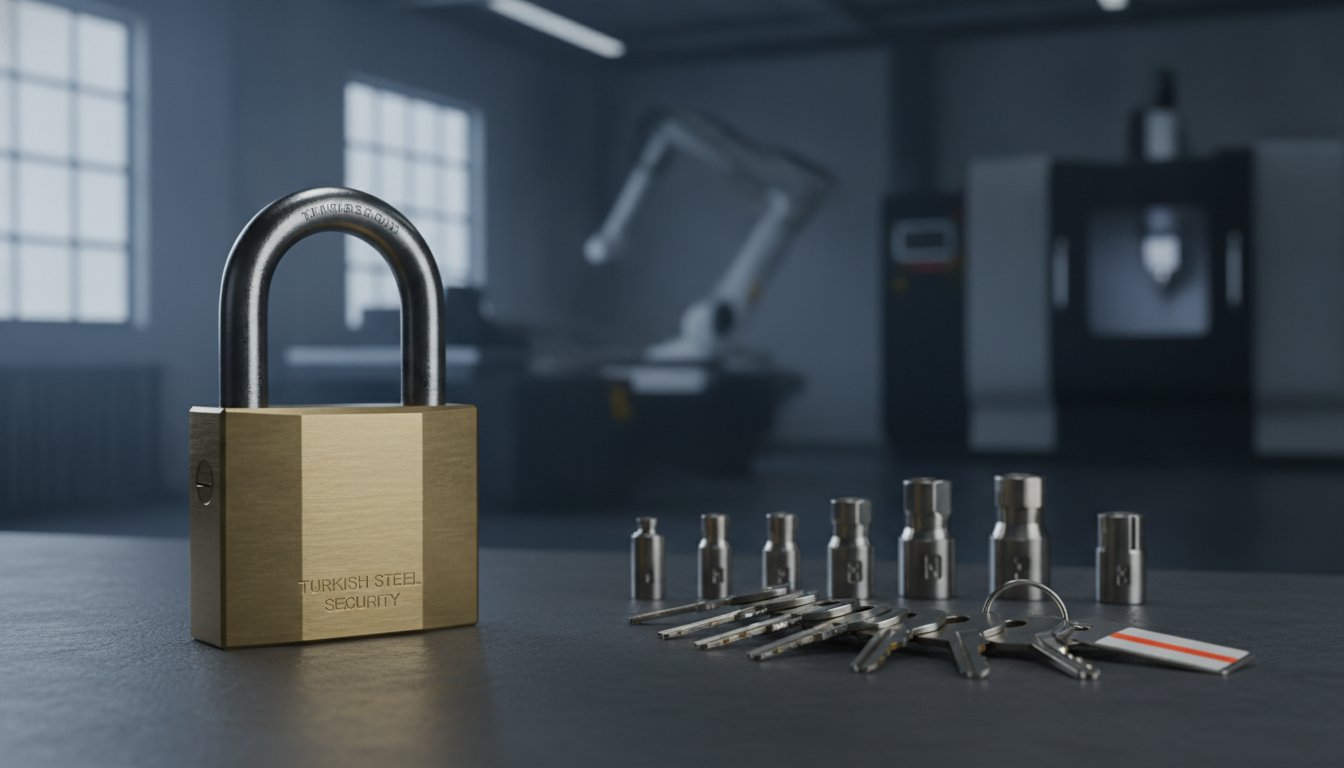
Entrusting the security of an industrial facility to an ordinary piece of metal actually means putting the facility’s entire operational continuity and assets at risk. High-security padlocks used in industrial environments are more than simple locking devices; they are strategic protective barriers shaped by modern engineering principles and precision manufacturing techniques.
For factory managers and procurement professionals, dealing with the confusion caused by hundreds of keys and constantly replacing locks that rust or jam under harsh outdoor conditions creates a significant operational burden. The inability of low-quality equipment to withstand theft attempts can also lead to losses that are difficult to recover. By optimizing both physical resistance and access control within your facility, you can minimize these risks. In this comprehensive guide, you will discover how to take security beyond basic standards while improving organizational efficiency.
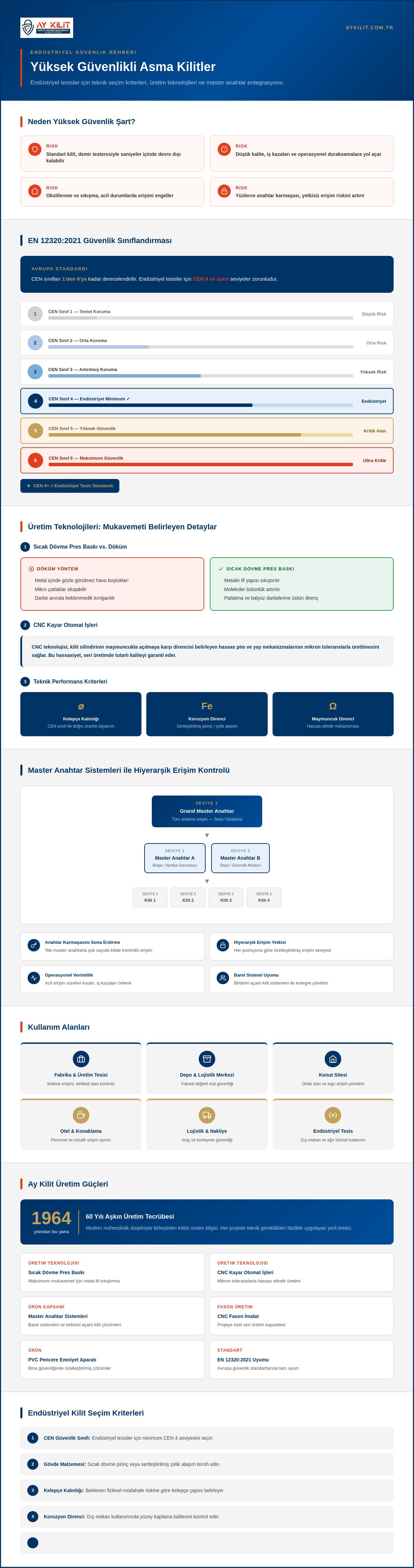
Drawing on Ay Kilit’s manufacturing experience dating back to 1964, we will examine EN 12320:2021-compliant locking mechanisms, the hierarchical control advantages offered by master key systems, and the impact of technical details such as hot-forged brass bodies on operational durability.
Key Takeaways
- Learn about international standards and technical lock selection criteria that maximize security in industrial facilities.
- Discover the critical role of hot forging and CNC sliding-head machining technologies in lock durability.
- See how master key systems provide hierarchical access control and eliminate operational key management complexity.
- Use technical comparisons between different mechanisms and shackle designs to select the most suitable high-security padlocks for your facility.
- See how Ay Kilit brings project-specific industrial locking solutions to life with expertise dating back to 1964.
Contents
What Are High-Security Padlocks? Industrial Standards
In industrial environments, security is not merely about keeping a door closed; it is about safeguarding operational continuity. High-security padlocks, unlike standard models, are specifically designed for heavy-duty use and resistance to organized theft attempts. When the basic components of padlocks are examined, it becomes clear that the body structure, shackle strength, and locking mechanism are engineered as an integrated system to withstand the most demanding forms of physical attack. While a standard lock may be defeated with a simple hacksaw within seconds, an industrial-grade product must successfully withstand cutting, drilling, and impact tests.
A lock cannot be classified as high-security simply because it looks robust. Technical parameters such as the lock cylinder’s resistance to picking, the shackle’s tensile strength, and the body’s corrosion resistance are decisive. At Ay Kilit, we have applied these technical requirements meticulously at every stage of production, drawing on experience accumulated since 1964. The durability required by industrial facilities can only be achieved through the correct selection of materials and precision engineering.
Security Classification and Certifications
The EN 12320:2021 standard, applicable across Europe, defines the current criteria for determining padlock security levels. Under this standard, locks are classified into CEN grades ranging from 1 to 6. CEN 4 and above are generally preferred for industrial facilities. At these levels, shackle thickness and material hardness play a critical role. Hot-forged brass bodies or hardened steel alloys in particular increase impact absorption capacity and maximize resistance against shock attacks. We achieve precision in locking mechanisms through CNC sliding-head machining, while enhancing body durability by combining traditional craftsmanship with modern forging techniques.
Why Is High Security Essential in Industrial Facilities?
Factories, logistics centers, and warehouses contain assets of significant financial value. Unauthorized access to these areas represents not only a theft risk but also the possibility of workplace accidents and operational downtime. Standard locks may not withstand the corrosive effects of outdoor environments. Over time, oxidation of the lock cylinder or jamming of the mechanism can prevent access during emergencies and reduce operational efficiency. Our padlock solutions provide both a physical barrier against theft and long-lasting performance through corrosion resistance. In a corporate security strategy, the physical durability of locks is just as important as their compatibility with facility-wide master key systems.
Manufacturing Technologies: Engineering Details That Determine Strength
The quality of an industrial lock is directly related to how its raw material is processed. The techniques used in manufacturing high-security padlocks determine how effectively the product can withstand physical attacks. Although many procurement professionals focus only on appearance or shackle thickness, true protection lies in the molecular structure of the metal and the precision of the internal mechanism. Padlock mechanisms and body structures must undergo specialized manufacturing processes to withstand the demanding working conditions of industrial facilities. At Ay Kilit, we have managed these processes according to modern engineering principles since 1964.
Hot Forging vs. Casting: Which Is Stronger?
There is a significant difference in strength between casting and forging in metalworking. Cast lock bodies are produced by pouring molten metal into a mold, a process that can leave invisible air pockets and microcracks within the material. Under severe impact, cast bodies may exhibit unexpected brittleness. The hot forging process, on the other hand, shapes heated metal under high pressure. This process compresses the grain structure of the metal and improves structural integrity. The technique used on our production line gives the lock body exceptional resistance to impact and heavy blows.
CNC Technology for Precision Mechanisms
No matter how strong the body is, security cannot be achieved if the lock cylinder is not manufactured precisely. In high-security padlocks, lock cylinders and keyways must be produced with extremely tight tolerances. CNC sliding-head machining allows us to reduce tolerance ranges to micron levels. This technical precision makes picking attempts significantly more difficult while ensuring that the key turns smoothly inside the cylinder. Wear-resistant brass and steel components help the locking mechanism maintain its operational efficiency even after thousands of locking and unlocking cycles.
Brass is preferred in outdoor environments because of its natural corrosion resistance, while hardened steel shackles are critical for resistance to cutting. Depending on the environmental conditions of your facility, corrosion resistance can be further enhanced through electrostatic powder coating or specialized electroplating technologies. These meticulous engineering details reduce long-term maintenance costs and optimize security. We can analyze your facility’s technical requirements and select the most suitable materials together.
Security Levels and Mechanism Types
The physical security of an industrial facility begins with the mechanical core of the padlock. High-security padlocks incorporate lock cylinders and shackle structures designed to resist different types of attacks. Simply manufacturing a lock from steel is not enough. The sophistication of the mechanism is just as critical as the hardness of the body. At Ay Kilit, we analyze the risk profile of each project and recommend the most appropriate mechanical design. The protection of doors, warehouses, or machinery within your facility is directly related to the technical capabilities of the selected locking mechanism.
Pin tumbler systems are among the most widely used locking mechanisms. In industrial-grade applications, increasing the number of pins and using specialized key profiles raises the security level. Disc mechanisms provide strong resistance to picking and perform well in dirty working environments. Combination models may be preferred in temporary areas where key management is difficult. For the highest security levels, keyed and patented systems generally come to the forefront. These systems provide advanced protection against both physical attacks and technical opening attempts.
The Impact of Shackle Design on Security
The shackle may appear to be the weakest point of a lock, but the correct design can turn it into one of its strongest components. Hidden-shackle models conceal most of the shackle inside the body, significantly reducing access for bolt cutters. Long-shackle models provide greater installation flexibility but must be evaluated differently in terms of physical resistance. In all our padlock products, shackles are manufactured from hardened steel subjected to specialized heat-treatment processes. This provides both flexibility and maximum resistance to cutting. Selecting the correct shackle diameter according to the door or enclosure structure is a fundamental step in making the security barrier more difficult to defeat.
Cylinder and Keying Technologies
The keying technology inside the lock is one of the most important barriers against unauthorized key duplication. Advanced systems incorporate hardened steel anti-drill pins and specialized key profiles. Controlling unauthorized duplication protects the facility against uncontrolled access. Ay Kilit’s padlock master key solutions use this sophisticated keying infrastructure to provide comprehensive control through a single key. Increasing the number of pins dramatically expands the number of possible combinations, making manipulation substantially more difficult. Physical resistance reaches its full potential only when combined with a precisely engineered internal mechanism. The hierarchical systems we design for facilities are built on this high level of cylinder precision.
Master Key and Padlock Integration in Corporate Operations
The security of an industrial facility is measured not only by the physical strength of its hardware but also by how that hardware is managed. In a facility with hundreds of doors, warehouses, and machine rooms, key management complexity can significantly slow down operations. High-security padlocks, when integrated with a properly designed master key system, provide both physical protection and administrative control. Drawing on experience dating back to 1964, Ay Kilit plans hierarchical access requirements according to modern engineering principles.
Balancing operational speed and security in facility management requires professional planning. Carrying a separate key for every lock reduces staff efficiency, while restoring security after a lost key can become costly. Master key applications eliminate this complexity by ensuring that each employee can access only the areas for which they are authorized. This structure strengthens internal discipline while minimizing risks arising from unauthorized access.
In addition, to improve the efficiency of logistics processes and establish a professional infrastructure in loading areas, modern loading systems and industrial closure solutions offered by komabram.com are among the complementary elements of facility security.
Hierarchical Lock Planning
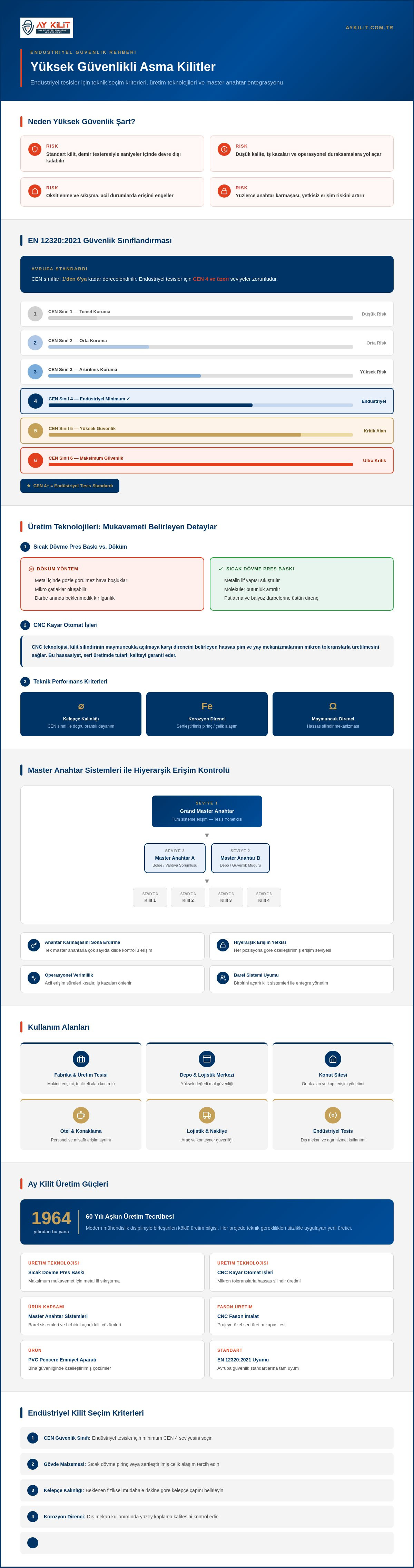
Hierarchical access planning is structured according to the organization chart of the facility. The Grand Master key is authorized to open all locks throughout the facility and is generally held by senior security personnel or facility managers. Sub-master keys provide access only to specific departments, such as shipping areas or electrical rooms. User keys allow employees to open only the locks within their own areas of responsibility. With this structure, the loss of a single key does not necessarily compromise the entire system; the affected section can be rekeyed to mitigate the risk.
Convenience of Keyed-Alike Lock Systems
In some operational scenarios, ease of use takes priority over hierarchy. Keyed-alike systems are based on configuring a group of locks to operate with the same key. This provides a major advantage for logistics fleets, container security, and periodic maintenance teams. Maintenance personnel can use a single key for multiple high-security padlocks located throughout the facility, allowing them to focus on their work rather than managing heavy key rings. This approach saves time in logistics operations while reducing key management complexity. To establish a professional access control infrastructure for your facility, you can contact our specialist team and plan your project.
Ay Kilit: Project-Specific Industrial Locking Solutions
Industrial security is not simply about purchasing a product; it is a long-term partnership. With manufacturing experience dating back to 1964, we combine Türkiye’s domestic manufacturing strength with modern engineering principles. The high-security padlocks required by industrial facilities are not merely metal components to us; each is a carefully engineered security solution. At Ay Kilit, we combine the craftsmanship developed through decades of experience with an advanced machinery infrastructure to remain a reliable solution partner for industrial facilities.
Our manufacturing capacity extends beyond standard models to include project-specific design and serial production. Through our hot forging capabilities, we achieve high structural strength in lock bodies. At the same time, CNC sliding-head machining provides precise tolerances in locking mechanisms. This flexible manufacturing infrastructure allows us to produce hardware tailored to the physical conditions and risk profile of your facility while maintaining demanding quality standards.
Corporate Advantages of Domestic Manufacturing
For industrial facilities, time is one of the most critical cost factors. Long lead times and customs procedures associated with imported products can put operational continuity at risk. As a domestic manufacturer, Ay Kilit helps eliminate this problem through fast logistics across Türkiye. For technical procurement professionals, dealing directly with the manufacturer means having access to technical support throughout every stage of the project. Furthermore, when a facility expands, additional locks fully compatible with existing master key systems can be supplied quickly without compromising system continuity. The speed provided by domestic manufacturing in spare parts supply and technical revisions directly improves corporate efficiency.
Project-Based Security Planning
Every industrial facility has its own unique layout and security hierarchy. Our approach is to analyze the physical conditions of the facility and select the most appropriate materials and mechanisms. For a coastal logistics center, we may recommend corrosion-resistant brass-bodied high-security padlocks, while in heavy industrial environments, steel alloys with enhanced impact resistance may take priority. When designing the master key hierarchy for your padlock systems, we also consider future expansion projections to create a sustainable access control infrastructure.
Share your requirements with us, and let us plan the right solution for your project together.
Sustainable and Professional Approaches to Industrial Security
Industrial facility security should not rely on randomly selected hardware but on a strategy developed with technical precision. As examined throughout this guide, hot forging technology, which forms the foundation of physical resistance, and professional master key system expertise, which improves operational speed, are essential components of a modern industrial facility. Since 1964, we have combined domestic manufacturing capabilities with modern engineering principles to deliver these two critical elements to demanding standards.
The high-security padlocks you choose for your facility are not merely security devices; they also safeguard operational continuity and corporate assets. At Ay Kilit, we combine decades of expertise with project-specific solutions. By analyzing your technical requirements with the precision of a manufacturer, we help establish the most efficient security hierarchy for your facility. With the correct hardware selection, you can reduce maintenance costs and build a reliable controlled-access infrastructure.
In addition to physical security, explore Varoitusmerkit products to improve traffic safety in internal logistics areas and establish a comprehensive protection strategy.
Share your requirements with us, and let us plan the right solution for your project together.
Frequently Asked Questions
What should you consider when buying a high-security padlock?
Compliance with EN 12320:2021 and the applicable CEN security grade should be among the first technical criteria considered. The specification should also cover shackle material hardness, body impact resistance, and the level of protection provided by the lock cylinder against technical opening methods such as picking.
How can outdoor padlocks be protected against rust?
Brass-bodied lock models are naturally resistant to corrosion and are therefore a strong option for outdoor applications. Electrostatic powder coating or specialized electroplating technologies applied during Ay Kilit’s manufacturing process can further reduce corrosion risk by limiting the metal’s exposure to moisture and oxygen.
Can a master key system be added to existing padlocks later?
This is generally not possible with ordinary retail padlocks; however, integration may be possible with specialized cylinder systems manufactured by Ay Kilit. When master key systems are planned from the beginning of a project, the facility’s hierarchical access control can be structured more efficiently and securely.
Which is more secure: a steel padlock or a brass padlock?
Steel locks offer greater hardness against physical attacks and impacts, while brass locks stand out for their corrosion resistance. High-security padlocks often combine the advantages of both materials by using a corrosion-resistant brass body together with a hardened steel shackle designed to resist cutting.
How can a padlock’s resistance to cutting be increased?
Choosing hidden-shackle models limits access to the shackle with cutting tools such as bolt cutters, significantly improving resistance. In addition, using shackles that have undergone specialized heat-treatment processes and are manufactured from hard alloys such as boron steel directly improves physical strength.
How much time can keyed-alike lock systems save businesses?
These systems eliminate the need for personnel to select among dozens of different keys, providing meaningful time savings in daily operations. For logistics fleets or periodic maintenance teams in particular, accessing multiple locks with a single key can improve operational speed and employee efficiency.
Does Ay Kilit offer controlled key duplication services?
Yes, particularly for master key systems and specialized cylinder projects, controlled duplication services can be provided upon the request of authorized personnel. Processes based on a security card or formal authorization mechanism help prevent uncontrolled and unauthorized duplication of keys within the facility.
How often should locks in industrial facilities be maintained?
In industrial environments with high levels of dust, humidity, or chemical vapors, locks should generally be inspected and maintained at regular intervals appropriate to the operating conditions. During maintenance, suitable dry lubricants such as graphite-based products may help reduce contamination inside the mechanism and support reliable operation of the cylinder and pins.