True security in locking systems begins not only with the keyway design, but also with the molecular strength of the metal used in the cylinder body. Many technical procurement professionals and facility managers struggle with chronic problems such as low-quality alloys oxidizing over time or insufficient cylinder precision in master key systems. At this point, engineering solutions offered by professional brass cylinder manufacturers provide a critical foundation for the long-term and secure implementation of large-scale projects.
To help you achieve the highest efficiency in your corporate projects, we explain cylinder manufacturing processes, material advantages, and the criteria for selecting the right manufacturer in technical detail. From hot forging press technology to CNC-supported precision mass production, you will find all the parameters that determine the operational life of locking mechanisms in this article. From compliance with EN 1303:2026 standards to the installation of master systems that provide hierarchical access control, we examine the technical details you need to know about modern cylinder systems.
Key Points
- You will learn in technical detail how the high corrosion resistance and low coefficient of friction of brass extend the service life of locking mechanisms.
- You will discover the superior protection against physical force provided by the molecular strength that hot forging press technology gives to the cylinder body.
- You will understand why working with professional brass cylinder manufacturers is critical for accurately configured master key systems and hierarchical access control.
- You will be able to evaluate the contribution of custom manufacturing processes compliant with technical specifications to operational efficiency in large-scale projects such as factories, hotels, and warehouses.
- You will see how to maximize facility security with cylinder systems fully compliant with EN 1303:2026 standards.
Contents
What Is a Brass Cylinder? Its Critical Importance in Locking Systems
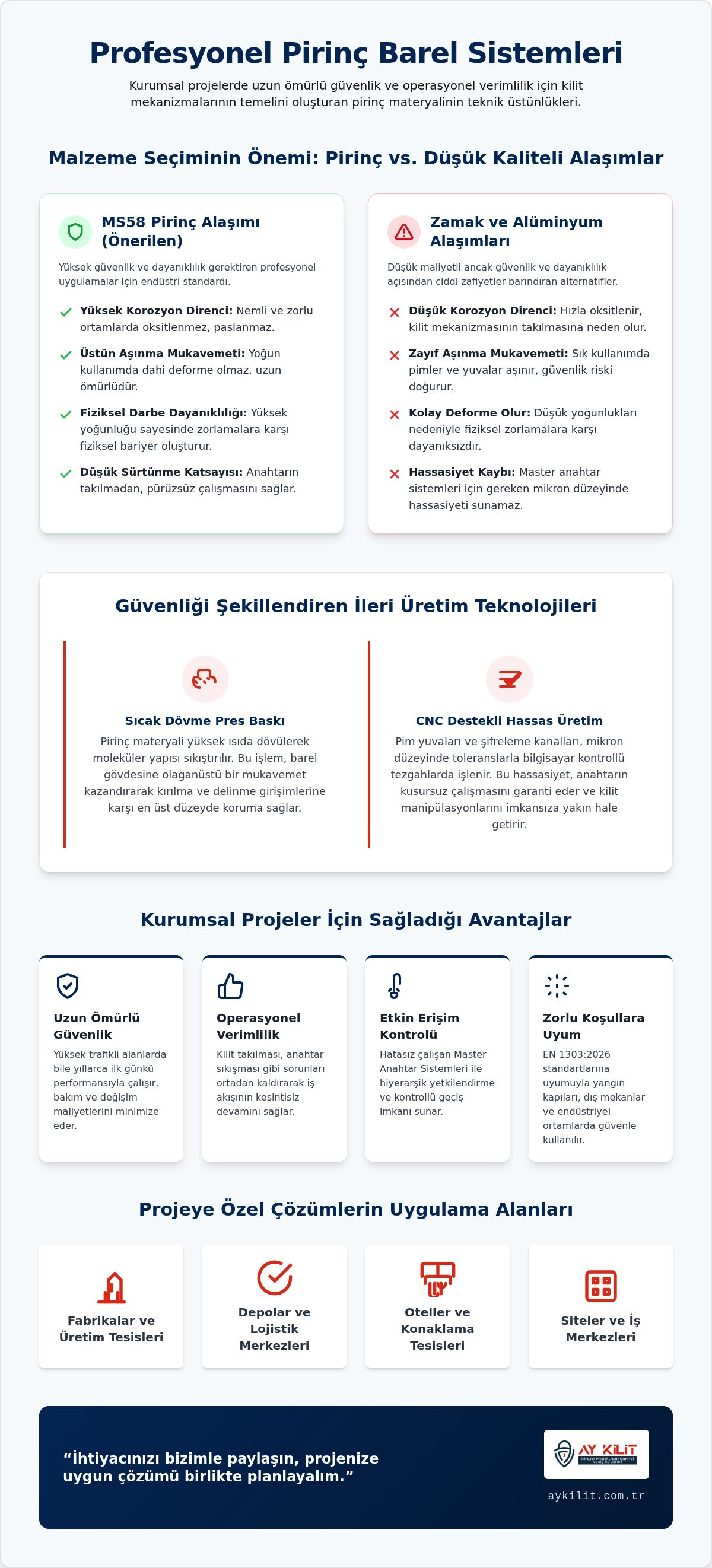
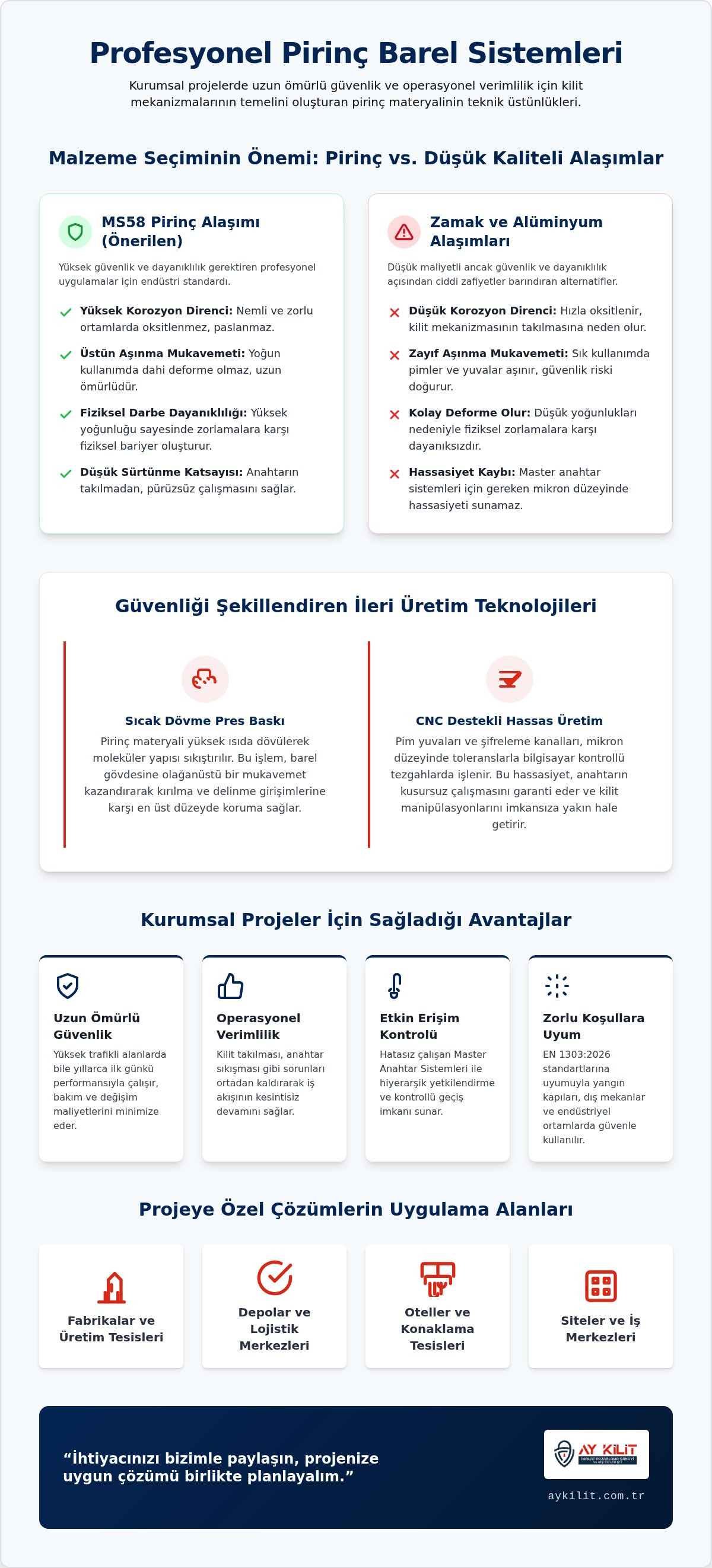
The lock cylinder, commonly referred to as the cylinder, is both the security and coding center of door locking systems. This component, where the key interacts with the locking mechanism, is the most fundamental element determining system reliability. In industrial projects and high-security areas, material selection is not a preference but a technical necessity. Professional brass cylinder manufacturers use MS58 brass alloy to maximize mechanical strength. Brass naturally offers high corrosion resistance and a low coefficient of friction. This characteristic allows the locking system to operate smoothly for years without jamming.
In B2B projects, it is necessary to go beyond standard retail products. In environments such as factories, warehouses, or hotels, the intensity of lock usage causes softer metals such as zamak or aluminum to wear rapidly. Brass, thanks to its metallurgical structure, retains its form at high-traffic access points. The number and arrangement of pins determining the security level are machined within the brass body with micron-level precision. This precision increases resistance to lock manipulation while also making unauthorized duplication more difficult. Our manufacturing experience dating back to 1964 has confirmed in every project the direct impact of material quality on the security of cylinder systems.
Basic Components of a Cylinder Mechanism
A cylinder is a complex engineering product consisting of a body, plug, pins, and springs. When the question What Is a Brass Cylinder? is approached from a technical perspective, the process in which the pins align with the key profile and allow the plug to rotate comes to the forefront. Brass minimizes friction between these components and helps prevent wear. Components manufactured with precise tolerances directly affect how smoothly the key enters and exits the cylinder. Using CNC technology to keep these tolerances within the narrowest possible range maximizes the system's resistance to manipulation.
Cylinder Usage Scenarios in Industrial Areas
In industrial facilities, cylinder selection is directly related to operational continuity. Heavy-duty doors and outdoor entrances are exposed to demanding external factors such as humidity and extreme temperature fluctuations. Brass cylinders resist oxidation under these conditions, helping prevent lock jamming. Their full compatibility with fire doors and panic bar systems also supports the safety of emergency evacuation plans. Cylinders integrated with master key systems enable hierarchical access control in large-scale facilities, eliminating key management complexity. These systems provide operational convenience across a wide range of environments, from factories to hotels.
Why Do Brass Cylinder Manufacturers Prefer Brass?
Material selection in lock manufacturing is the most critical decision determining both product security and operational lifespan. Specialized brass cylinder manufacturers regard MS58, or CW617N, alloy as a standard choice for high-quality lock cylinders. Thanks to its balanced copper and zinc composition, this alloy provides an ideal metallurgical structure for lock manufacturing. Unlike alternatives such as zamak or aluminum, brass offers superior resistance to impact and wear. Its ability to be machined on CNC equipment with micron-level precision ensures perfect interaction between lock pins and coding chambers. This precision is the fundamental factor that allows the key to rotate smoothly inside the cylinder without jamming.
Material density is particularly important when selecting cylinders for industrial facilities and large-scale projects. Brass provides a physical barrier against forced-entry attempts due to its high specific weight. While many manufacturers turn to cheaper alloys with a cost-focused approach, professional brass cylinder manufacturers do not compromise on quality standards. Brass is preferred because this material helps the locking mechanism maintain its original performance for years. To determine the products with the most suitable technical specifications for your project, you can contact our expert team.
Corrosion and Oxidation Resistance
Brass alloy is known for its stability under outdoor conditions. In coastal buildings or industrial facilities with high concentrations of chemical vapors, oxidation of locks can become a serious security problem. Brass forms a natural barrier against corrosion in these environments. In addition, the material's natural lubricity reduces friction between the internal components of the locking mechanism. This makes brass an effective solution for businesses seeking a corrosion-resistant lock cylinder. Our manufacturing experience since 1964 has demonstrated that brass cylinders minimize maintenance costs and support system continuity.
Mechanical Strength and Burglary Resistance
High-security cylinders stand out not only through their primary material but also through their internal technical reinforcements. Drill-resistant steel pins integrated into the brass body help neutralize drilling attacks. The dense structure of brass allows these steel reinforcements to remain firmly secured within the body. Special body designs that improve resistance to snapping are made possible by the balance between brass's flexibility and hardness. When selecting a high-security cylinder, material density is the first and most important factor in resistance to forced entry. This durability takes security to a higher level in large-scale warehouse and factory environments.
Cylinder Manufacturing Technologies: Hot Forging and CNC Precision
A promise of superior security is achieved not only by selecting the right material but also by processing that material with the highest level of engineering precision. Professional brass cylinder manufacturers combine two fundamental disciplines in their production processes: hot forging and CNC precision. Hot forging press technology is the process of shaping brass alloy under enormous pressure at elevated temperatures. This process compacts the metal structure, producing a much stronger and less porous body than conventional casting methods. At Ay Kilit, with our hot forging press lines and manufacturing expertise dating back to 1964, we produce cylinder bodies designed to provide strong resistance against mechanical force.
Once the body has been formed, the internal mechanisms responsible for the cylinder's core function are machined using CNC sliding-head automatic lathe technology. Machining coding channels and pin chambers with micron-level accuracy is one of the most important factors in protecting locking systems against manipulation. Manufacturing in accordance with high-security lock system standards requires millions of different coding combinations to be configured accurately. Thanks to modern automation systems, we maintain consistent quality in mass production and ensure that every product meets the same technical precision requirements. This technological infrastructure enables us to respond rapidly to requirements for non-standard dimensions or specifications in large-scale projects.
Hot Forging vs. Casting: Which Is More Secure?
Casting involves melting metal and pouring it into a mold, a process that may leave microscopic voids within the material. These voids can make the cylinder more vulnerable to breaking during physical attacks. Hot forging, on the other hand, directs the metal's grain structure without disrupting it, creating a dense structure with high impact resistance. In industrial cylinder production, forged cylinders become especially important for high-traffic areas and outdoor security applications. One of the key factors distinguishing us among brass cylinder manufacturers is our ability to combine this forging capability with modern CNC manufacturing discipline.
Precision Coding with CNC Automatic Machining
Machining dimple and standard keyways requires advanced CNC automatic machining and CNC contract manufacturing capabilities. Precision machining minimizes tolerances between the pins and springs inside the cylinder. This enables the key to operate smoothly within the cylinder while increasing resistance to unauthorized manipulation techniques such as picking. The ability to produce millions of different combinations provides a comprehensive response to businesses' hierarchical access control requirements. Every lock cylinder leaving our production line reflects this precision engineering process.
Master Key and Cylinder Integration in Corporate Projects
Master key systems are strategic engineering solutions where corporate security meets operational efficiency. Managing hundreds of doors with different keys in large-scale facilities creates security vulnerabilities and can significantly slow emergency response. Professional brass cylinder manufacturers provide technical infrastructures designed to eliminate this complexity through hierarchical access control. With these systems, a facility manager can open all authorized doors with a single key, while employees can access only the areas assigned to them. This configuration not only improves ease of use but also minimizes key management costs.
In hotels, factories, and residential complexes, these systems eliminate key management complexity and depend directly on the coding precision of the cylinder systems. Each cylinder is manufactured as part of the master system using precise tolerances and strict production standards. With manufacturing experience dating back to 1964, we create scalable configurations for corporate projects that maintain system integrity as your facility grows. Master key systems provide a controlled access network fully aligned with your organization's security protocols.
Keyed-alike lock systems also provide significant operational advantages. For example, all perimeter gates of a factory or all storage areas of a hotel can be managed with a single key group. This eliminates the need for personnel to carry dozens of keys while clearly defining which cylinders must be addressed if a key is lost. A system designed by the right brass cylinder manufacturers should continue to provide spare parts and additional cylinders manufactured to the same technical standards even years after the initial installation.
How Is Hierarchical Access Planning Performed?
Access planning is carried out through a detailed authorization matrix. At the top is the Grand Master key, which can open the entire designated system. Lower levels include department-specific Master keys and individual user keys that open only a single door or defined group of doors. In a factory master key system, for example, a production manager may open all workshops with one key, while an operator can access only their assigned work area. In logistics centers and warehouse master key applications, padlocks can also be integrated into this hierarchy to create comprehensive security.
Adding New Cylinders to Existing Systems
When facilities expand or new sections are added, system scalability becomes critical to the future of the project. Working with a manufacturer that has strong technical capabilities allows new cylinders compatible with the existing master system to be produced accurately. Correctly determining cylinder dimensions, whether standard, thumbturn, or asymmetric, helps prevent installation errors. Within corporate key management, registered key profiles can also help prevent unauthorized key duplication. Contact us for a master key system configuration tailored to your project.
Ay Kilit: Custom Brass Cylinder and Lock Solutions
Ay Kilit has been one of the established companies in lock and cylinder manufacturing since 1964. More than half a century of experience has positioned our brand not only as a supplier but also as a trusted engineering partner for corporate projects. Among Turkey's domestic brass cylinder manufacturers, our facility combines hot forging and CNC technologies in an integrated production structure, blending modern manufacturing discipline with traditional craftsmanship. Our ability to manufacture in full compliance with technical specifications prepared for factories, hotels, hospitals, and large-scale logistics centers helps elevate project security standards to an international level.
Our high-volume production capacity provides operational speed, particularly for large-scale projects where delivery deadlines are critical. As a direct manufacturer, we eliminate intermediaries, enabling technical requirements to be addressed rapidly and project-specific modifications to be implemented accurately. Our after-sales technical support and continuous spare-parts availability help secure the operational life of installed locking mechanisms. Every product processed on our hot forging and cold forging lines reflects Ay Kilit's commitment to quality.
Why Should You Work with Ay Kilit?
Working directly with a manufacturer provides both cost control and technical transparency for your projects. Ay Kilit uses MS58 brass alloy and CNC sliding-head automatic lathe technology to manufacture precise cylinder systems even within extremely narrow tolerances. What distinguishes us among professional brass cylinder manufacturers is our ability to respond flexibly to a wide range of technical requirements, from custom dimensions to high-security dimple cylinders. The variety we offer across padlock and cylinder product groups helps bring all access points within your facility under a consistent security standard.
Let's Plan Your Project Together
Facility security is not merely about product installation; it is the process of designing the right access architecture. Our expert technical team supports you in creating the master key configuration best suited to your facility's physical structure and personnel hierarchy. Through on-site or remote consultancy services, we minimize technical risks before procurement and develop solutions tailored to your organization. Share your requirements with us and let's plan the right solution for your project together.
Build the Security Standards of the Future with Engineering
When the corrosion resistance of brass is combined with the structural strength provided by hot forging technology, it creates a strong security foundation for your business. The hierarchical access control required by modern facilities can become sustainable only through cylinder systems machined with micron-level precision. Specializing in lock manufacturing since 1964, Ay Kilit brings this engineering discipline to businesses of all sizes through its experience in master key systems and corporate projects.
As one of Turkey's established brass cylinder manufacturers, our company adds speed, flexibility, and quality to your projects with hot forging and CNC-supported high-capacity production lines. With manufacturing processes aligned with technical specifications and continuous after-sales technical support, you can entrust your facility security to an experienced professional partner. We are here to support you with locking solutions that improve operational efficiency and provide a controlled access network. Share your requirements with us and let's plan the right solution for your project together. We will be pleased to help you configure the most suitable technical infrastructure for your security requirements.
Frequently Asked Questions
Why are brass cylinders more expensive than other lock cylinders?
The cost of brass cylinders is primarily related to the metallurgical value of MS58 alloy and its high corrosion resistance. Compared with cheaper alternatives such as zamak or aluminum, brass offers a much longer service life and reduces wear within the locking mechanism, helping lower maintenance costs. This investment provides operational continuity, particularly on high-traffic doors, and can therefore be more economical over the long term.
Can a master key system be applied to every type of cylinder?
A master key system can be applied to standard, thumbturn, or dimple cylinders whose technical infrastructure and pin capacity support the required hierarchy. However, as the hierarchy becomes more complex, the number of pins and coding precision within the cylinder must be capable of supporting that complexity. Ay Kilit cylinder systems are designed to accommodate even highly complex authorization matrices.
How should a lock cylinder be measured correctly?
The cylinder is measured from the center of the fixing screw hole toward both ends in millimeters. For example, a product measuring 30 mm internally and 30 mm externally is defined as a 60 mm standard cylinder. Door thickness, handle type, and the allowance required for the security escutcheon directly affect cylinder length, so accurate measurement is critical for proper installation.
How can you tell the difference between a hot-forged cylinder and a cast cylinder?
Hot-forged cylinders generally have a dense, smooth, non-porous structure compared with cast products. Because the metal structure is compacted during forging, these products offer greater resistance to impact. Cast cylinders may contain microscopic voids within the metal, which can make the product more susceptible to breaking under physical force.
Which cylinder type provides the highest resistance to burglary?
Brass cylinders reinforced with drill-resistant steel pins and strengthened against snapping provide a high level of physical security. Dimple key profiles can also offer greater resistance to manipulation techniques such as picking than basic conventional keyways, depending on the overall cylinder design. For facility security, compliance with EN 1303 requirements provides an important technical reference when assessing resistance to physical attack.
How should brass cylinders be maintained?
To maintain the performance of brass cylinders, applying a suitable dry lubricant or lock-specific lubricant to the keyway periodically is generally sufficient. Oil-based products can attract dust over time and may cause internal pins to stick, so products specifically designed for lock mechanisms should be preferred. Proper maintenance supports smooth key operation and extends the service life of the mechanism.
What technical information is required when ordering cylinders for a large facility?
The ordering process should clearly specify the number of doors, required cylinder dimensions for each door, and the master key hierarchy, if applicable. Professional brass cylinder manufacturers use this information to plan the appropriate security classifications and asymmetric dimensions according to the project's technical specifications. Accurate data sharing helps prevent compatibility problems during installation.
Do domestically manufactured cylinders comply with international standards such as TS EN 1303?
Domestic cylinders can be manufactured and tested in accordance with TS EN 1303 requirements when the manufacturer follows the applicable standard and conformity procedures. Ay Kilit combines its manufacturing experience dating back to 1964 with internationally recognized technical requirements to provide security solutions for professional projects. When evaluating products from brass cylinder manufacturers, buyers should verify the specific model's current test reports, classifications, and certificates rather than relying solely on a general manufacturer claim.